Is Bari Old Town Worth Visiting?
Yes: Bari Vecchia packs a basilica, a castle, two harbourside squares and a sea wall into a headland you can cross on foot in half an hour. What to see, what it costs and when to go.
Bari Vecchia, the old town of Bari on the Adriatic coast of Puglia in southern Italy, sits on a headland between the old port and the modern city, and it concentrates nearly everything the city is known for: the Basilica di San Nicola, the Cattedrale di San Sabino, the Castello Normanno-Svevo, Piazza Mercantile, Piazza del Ferrarese and the sea wall. It is a district measured in hundreds of metres, not kilometres, and it is the part of Bari that day trippers from Polignano a Mare, Alberobello and Matera come to see between trains. The Bari Italy Travel Guide coverage of the district starts from this page, which maps every landmark named here.
Is Bari Old Town Worth Visiting?
Yes, Bari Vecchia is worth visiting, and the reason is density: the Basilica di San Nicola is open Monday to Saturday from 06:30 to 20:30 and Sunday to 22:00 with no admission fee mentioned on its page, the Swabian castle costs 10 EUR full and 2 EUR reduced, and both stand within a few minutes' walk of Piazza Mercantile, Piazza del Ferrarese and the Muraglia sea wall. Few old towns in southern Italy put a pilgrimage basilica, a castle, two harbourside squares and a working quay on one walkable headland.
The verdict is an editorial judgement, but the facts behind it are concrete. The basilica holds the relics of Saint Nicholas, brought to Bari by sailors in 1087 and placed in the crypt in 1089, which is why the church draws pilgrims year round and why the city's patronal feast runs early every May. The castle, run by the Direzione regionale Musei Puglia, is a real museum with rotating exhibitions, not a shell. Between the two run lanes that open without warning onto the sea.
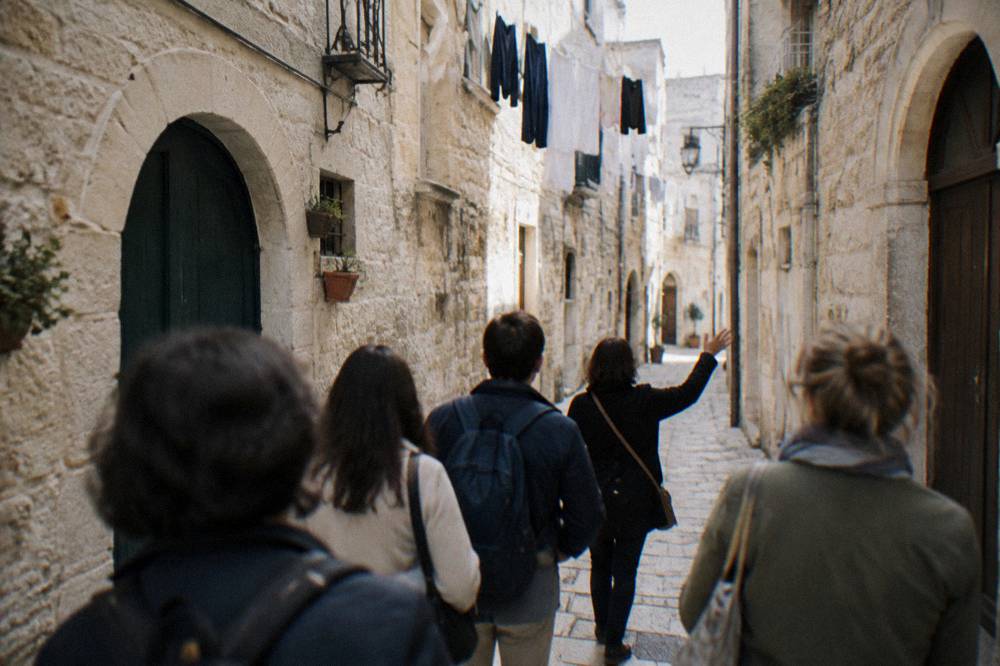
What the old town is not: a museum piece with velvet ropes. People live in Bari Vecchia, laundry hangs over the lanes, and the district holds a limited traffic zone with a camera gate at the Castello active since 1 July 2026, so it stays largely car-free by design rather than by accident. Arrive on foot or by bus and the district works in your favour.
What Makes Bari Vecchia Different From The Rest Of Bari?
Bari Vecchia is the medieval headland town, while Murat, the grid district immediately south, is the commercial city around Via Sparano, and the Lungomare Nazario Sauro runs along the sea past Madonnella toward the city beaches. The two halves of Bari meet at Piazza del Ferrarese and Piazza Mercantile, and you can stand with one in each eye: the tight stone lanes of the old town behind you, the regular grid streets ahead.
The contrast matters for planning. In the old town the streets are narrow, shaded and closed to most traffic, so walking is the only sensible pace. In Murat the blocks are regular, the shops are on Via Sparano, and the grid is easy to navigate with a map. Visitors who base themselves in Murat can walk into Bari Vecchia in minutes, cross it end to end, and come back out for dinner; the question is Bari a walkable city answers itself in this one district.
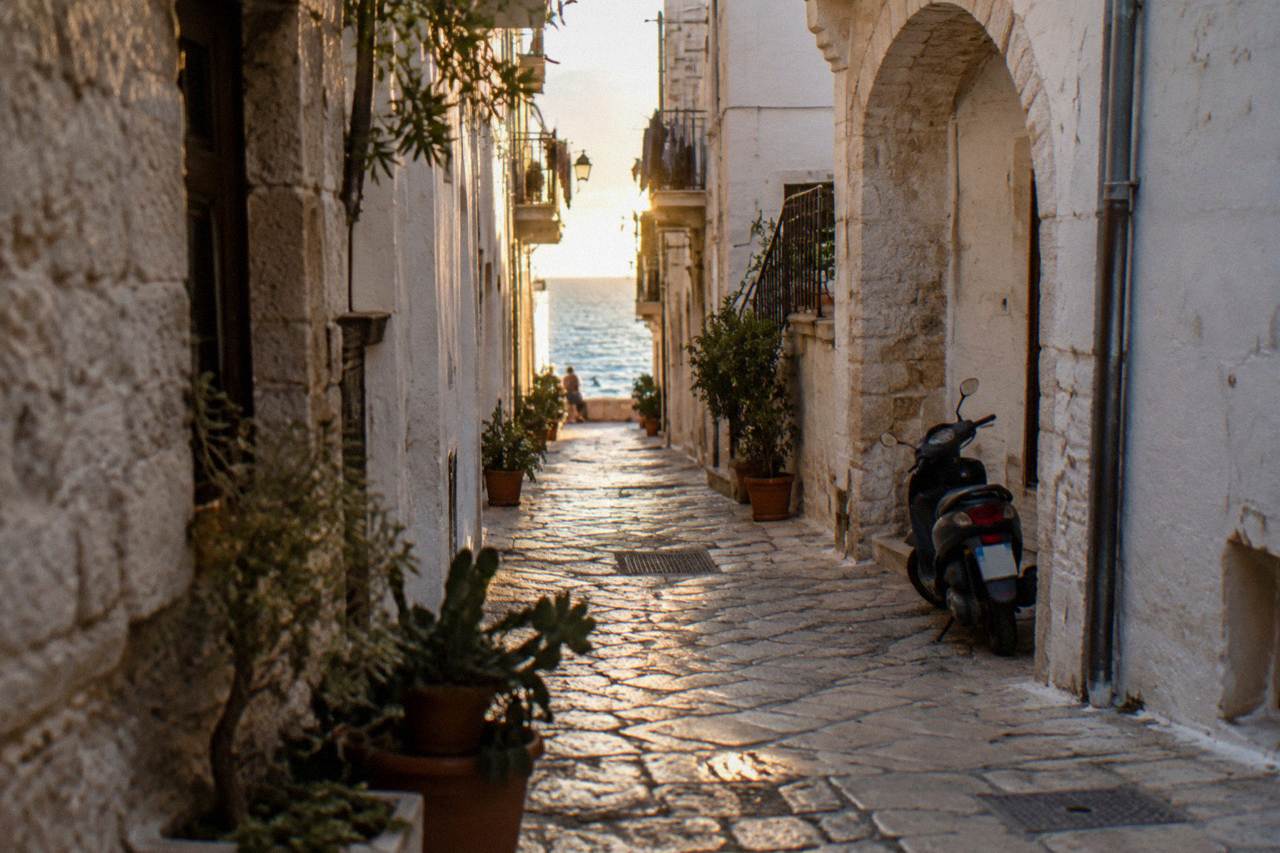
The old town also owns the seafront that photographs come from. The Muraglia, the sea wall on the north side, looks out over Molo San Nicola, the old-port quay, and out toward the Adriatic. A walk along the wall connects the Fortino di Sant'Antonio Abate, the little fort on the sea, to the swell of the Lungomare Nazario Sauro to the south.
A guided walk earns its price here for one reason: the old town explains itself badly. The lanes carry no interpretation, and the story of the 1087 relic translation, the successive layers of the churches and the role of the Swabian castle are the difference between a pretty wander and an informed one. The history walk above departs from Bari; the food-led variant covers the same lanes with tastings; and the third pick is a long day combining Matera and Alberobello, which departs from Alberobello once you transfer there, not from the Bari waterfront.
What Are The Key Sights Inside Bari Vecchia?
The four anchors are the Basilica di San Nicola (open daily, 06:30 to 20:30 Monday to Saturday and to 22:00 on Sunday, no fee mentioned), the Castello Normanno-Svevo (Tuesday to Sunday, 10 EUR full, 2 EUR reduced), the Cattedrale di San Sabino and the two squares, Piazza Mercantile and Piazza del Ferrarese. The Basilica's crypt holds the relics of Saint Nicholas, which rested at Myra for about 750 years before the 1087 transfer to Bari.
The castle's hours deserve a note before any itinerary: the Musei Puglia ticket page lists Tuesday to Sunday 09:00 to 19:00, with Sunday openings of 09:00 to 13:30 from October to March except the first Sunday of each month, when the full hours apply. The castle also appears among the state sites that open free on the first Sunday of the month, a scheme reported for October 2026, so confirm before you plan a first-Sunday visit. The Puglia Musei Card, at 20 EUR for six months, covers the regional state museums including the castle.
| Sight | Opening | Admission |
|---|---|---|
| Basilica di San Nicola | Mon-Sat 06:30-20:30, Sun 06:30-22:00 | No fee mentioned on its page |
| Castello Normanno-Svevo | Tue-Sun 09:00-19:00; Sun 09:00-13:30 Oct-Mar except first Sunday | 10 EUR full, 2 EUR reduced |
| Pinacoteca Metropolitana Corrado Giaquinto | Tue-Sat 09:00-19:00, Sun 09:00-13:00, closed Monday | 5 EUR full, 2 EUR reduced, 8 EUR combined |
| Museo Archeologico di Santa Scolastica | Tue-Sat 09:00-19:00, Sun from 09:00, closed Monday | 5 EUR full, 2 EUR reduced ages 18-25, combined ticket with the Pinacoteca |
| Teatro Petruzzelli guided tours | Dated slots published monthly | 7 EUR full, 2 EUR reduced |
Two of those sit outside the old town's lanes but within an easy walk: the Pinacoteca and the Santa Scolastica museum face the Lungomare, and the Teatro Petruzzelli stands just south of the old port. The Petruzzelli's own story is part of the draw: the theatre burned on the night of 26 to 27 October 1991 and reopened on 4 October 2009, a span reported in the standard accounts of the building. Guided tours cost 7 EUR full and 2 EUR reduced, with dated slots published monthly on the foundation's page.
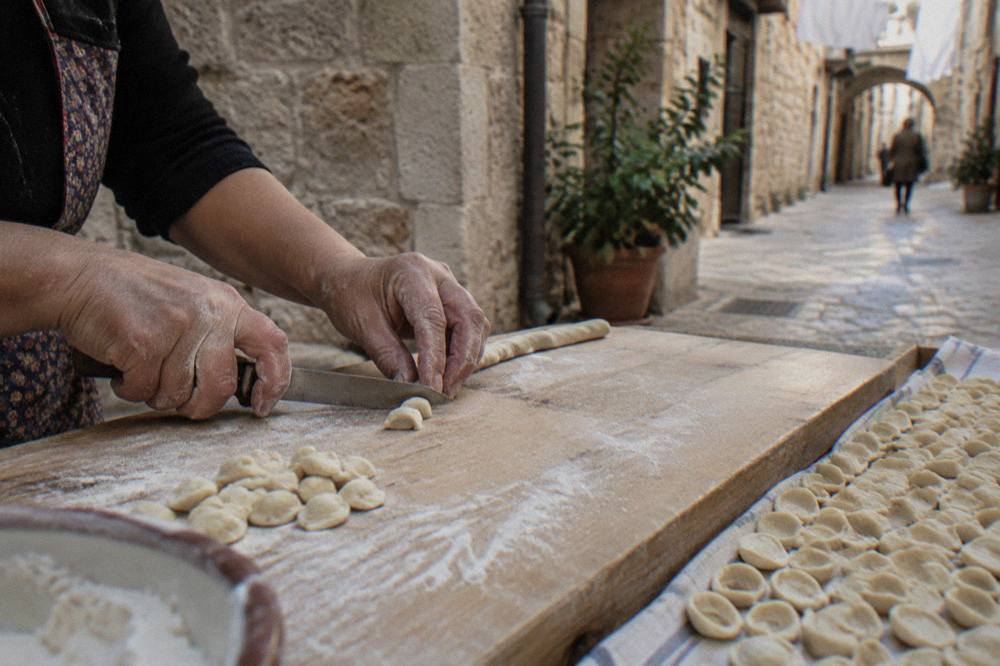
Around the anchors, the district's texture is the attraction. Piazza Mercantile and Piazza del Ferrarese are the two squares where the old town meets the modern city; the old port at Molo San Nicola is the quay below the wall; and Strada Arco Basso is a lane of the old town associated with hand-made pasta. Orecchiette is the pasta shape of Puglia, in one plain sentence, and beyond that the detail to keep loose: whether pasta makers are at work on any given day or at set hours is not something a published schedule confirms, so treat it as a possible encounter rather than a timetable item.
Where A Guided Walk Fits
A walk led by a guide who knows the layers covers the basilica, the castle district, the Muraglia and the squares in one loop, and it answers the questions the lanes do not answer themselves: why the relics came by sea, what changed around the squares, and how the headland grew. For visitors with one day in the city, it front-loads the orientation so the rest of the day is free.
How Much Time Does Bari Vecchia Need?
Half a day covers the basilica, the castle, the two squares and the Muraglia at a steady pace, and a full day adds the museums on the Lungomare, the Teatro Petruzzelli tour and a slow meal inside the lanes. The district is compact enough that the constraint is not distance but opening hours: the castle and both museums close on Mondays, so a Monday visit narrows to the basilica, the squares and the seafront.
A realistic minimum plan: start at the castle when it opens at 09:00, walk the basilica and its crypt after, come out through Piazza Mercantile and Piazza del Ferrarese, then take the Muraglia along the water to the Fortino. That loop is the core of the old town and it fits a morning. Cruise passengers get the same loop comfortably: the Stazione Marittima at Molo San Vito is about 0.5 km from Piazza Mercantile, so the walk into the old town is short, with the ship's all-aboard time as the only hard limit.
Visitors stretching to a second day should read the two days in Bari plan, which gives the old town one day and the Murat district, the Lungomare and a day trip the other. The question of how many days in Bari is enough has a short answer for this page's purposes: the old town itself needs hours, not days, but the city around it earns the extra time.
What Does A Visit To Bari Vecchia Cost?
The walk itself costs nothing, the two big museums cost 5 EUR each with an 8 EUR combined ticket, the castle costs 10 EUR and the Petruzzelli tour 7 EUR, so a full sightseeing day inside the district runs to roughly 30 EUR per adult in tickets at 2026 prices. The Basilica di San Nicola lists no admission fee on its page, and the squares, lanes and sea wall are public space.
| Item | Cost |
|---|---|
| Castle full ticket | 10 EUR |
| Castle reduced | 2 EUR |
| Pinacoteca or Santa Scolastica full | 5 EUR each |
| Combined Pinacoteca plus Santa Scolastica | 8 EUR |
| Teatro Petruzzelli guided tour | 7 EUR full, 2 EUR reduced |
| Puglia Musei Card, 6 months, regional state museums | 20 EUR |
The card deserves one line of arithmetic: at 20 EUR it beats the single-site sum for anyone visiting the castle plus at least one more regional state museum within six months, and it loses to buying singles if the castle is your only state-museum stop. The Museo Nicolaiano beside the basilica is reported at about 10:30 to 18:00, with one bulletin listing a Wednesday closure, so confirm before you go if it is on your list.
When Is The Best Time To Walk Bari Vecchia?
Late April to June and September to October are the comfortable windows: the climate table shows May at a 21.6 C mean daily high and October at 21.1 C, against 29.1 C in August, with about 4 rain days in July and August and 73 mm of rain in November against 20 mm in August. These are typical values from modelled ERA5 data, 1991 to 2020, and they describe the coast around the old town, which holds heat in the lanes in high summer.
Summer visits work with timing rather than avoidance. The basilica opens at 06:30, so the early-morning hours are available in July and August before the mean daily maximum of 28.6 C and 29.1 C arrives, and the evening reopening until 22:00 on Sundays gives a second window. Winter is quieter and cooler, with January and February highs about 12 C and rain near 60 mm a month; the castle's short Sunday hours from October to March are the main planning trap. The feast of San Nicola runs early May, 7 to 9 May by tradition, with the corteo storico on 7 May 2026 at 20:00 from piazza Federico II di Svevia, so that week is busy and vivid in equal measure.
What Should You Know Before You Go?
Do not drive into Bari Vecchia: the district is a limited traffic zone with a camera gate at the Castello, at piazza Federico II di Svevia at piazza Massari, active since 1 July 2026, with weekday windows reserved for authorised vehicles. Parking on the perimeter is paid on working days from 08:30 to 20:30, and the practical rule for rental-car drivers is to park outside and walk in.
Beyond the ZTL, the practicalities are ordinary city ones. Keep valuables out of back pockets and zip bags held in front on crowded buses, check posted prices and the itemised bill, and use 112 for emergencies, the standard EU number. On the food side, panzerotti, focaccia barese and raw seafood are the street-level signatures of the city, described one plain sentence each; the deeper answer lives in what food Bari is famous for territory, and a food-led walk of the lanes pairs it with the landmarks. English support on guided products is stated on each listing where it applies.
The second band above is the choice point: a history walk or a food walk for the lanes themselves, or the Matera and Alberobello long day if the old town is your morning and the afternoon belongs farther afield. All three are booked through the operator's live listing, and free cancellation terms are shown there before payment.
The honest close: Bari Vecchia earns its half day on the strength of the basilica, the castle, the sea wall and the density of it all, and it earns a full day only if museums and a slow lunch are on the plan. Treat it as the walkable heart of a city that otherwise spreads along the Adriatic, give it the morning, and let the rest of Puglia have the afternoon.
Common Questions About Bari Vecchia
Is Bari Old Town worth visiting?
Yes. The basilica is open daily with no fee mentioned, the castle costs 10 EUR, and both sit within a few minutes' walk of the squares and the sea wall, so a short visit delivers a pilgrimage church, a museum castle and a working old port on one headland.
How long do I need in Bari Vecchia?
Half a day covers the basilica, the castle, Piazza Mercantile, Piazza del Ferrarese and the Muraglia. A full day adds the Pinacoteca, the Santa Scolastica museum and a Teatro Petruzzelli tour, noting that the castle and both museums close on Mondays.
Can you drive into Bari Vecchia?
No. The district is a limited traffic zone with a camera gate at the Castello active since 1 July 2026, and perimeter parking is paid on working days from 08:30 to 20:30. Park outside the old town and walk in.
Is the Basilica di San Nicola free to enter?
The basilica's own page lists no admission fee. It opens Monday to Saturday 06:30 to 20:30 and Sunday 06:30 to 22:00, and the crypt holding the relics of Saint Nicholas is part of the same building.
Is Bari Vecchia safe at night?
No district-level safety verdict is stated as fact here. The ordinary city rules apply: keep valuables out of back pockets, zip bags in front on crowded buses, and call 112 in an emergency. The lanes are lit and busy through the evening meal hours in season.
What is the closest day trip from Bari Vecchia?
By rail from Bari Centrale, Polignano a Mare is 33 km down the Trenitalia Bari-Lecce line and Monopoli 41 km, both coastal towns with Blue Flag beaches in 2026, a status Bari's own city beaches do not hold. Check the operator's timetable for the current service.