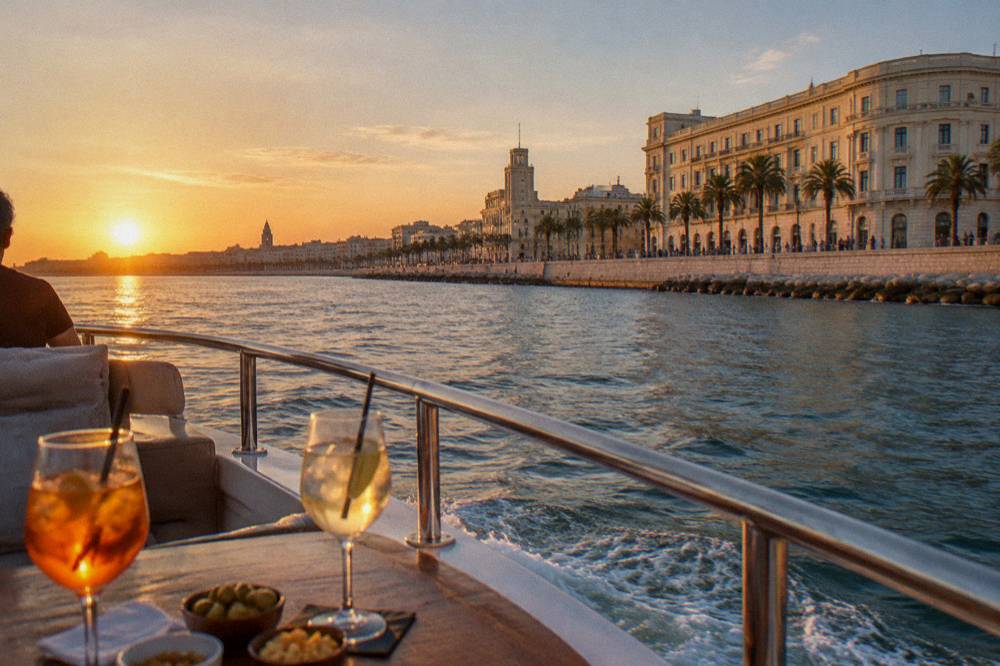
Lungomare Di Bari: The Seafront Promenade From The Old Port To Pane E Pomodoro
The Lungomare Nazario Sauro is the seafront promenade of Bari, the capital of Puglia on the Adriatic, running from the old port below Bari Vecchia towards the city beaches at Pane e Pomodoro. This guide covers what to see, museum hours, beaches, ferries and the tours that pair well with a day on the water.
Short answer
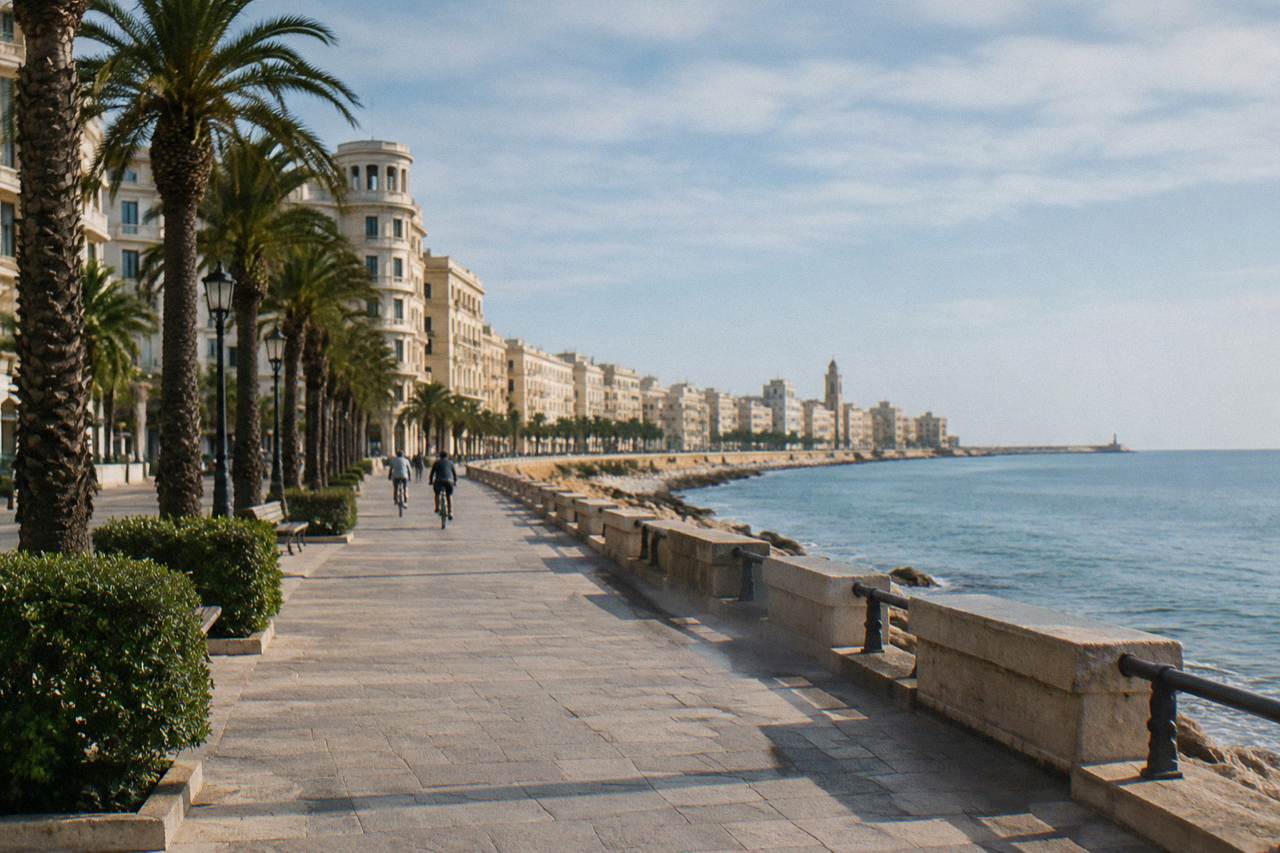
The Lungomare Nazario Sauro is Bari's public seafront promenade on the Adriatic, starting beside the old port and Teatro Margherita below Bari Vecchia and continuing south past Madonnella towards the city beach at Pane e Pomodoro, about 2.1 km from Piazza Mercantile. It is free to walk, served by AMTAB buses at 1.00 EUR a ride, and it is a promenade, not a swimming beach.
Bari, the capital of the Puglia region on the Adriatic coast of southern Italy, turns its face to the sea along the Lungomare Nazario Sauro. The promenade begins at the edge of the old town, Bari Vecchia, where the Teatro Margherita stands over the water and the old-port quay of Molo San Nicola still works, and it runs south past Madonnella towards the city beaches at Pane e Pomodoro and Torre Quetta. The Bari Italy Travel Guide covers the whole city district by district; this page stays on the waterfront, from the old port to the sand, with the hours, prices and day trips the sources actually give. What the promenade does not have is a swimming beach of its own: the city beaches sit beyond it to the south and north-west, and Bari itself holds no Blue Flag in 2026.
What Is The Lungomare Nazario Sauro In Bari?
The Lungomare Nazario Sauro is the seafront promenade of Bari, the regional capital of Puglia on the Adriatic Sea, running along the water from the old port below Bari Vecchia south past Madonnella towards the district of Japigia and the city beach at Pane e Pomodoro, about 2.1 km from Piazza Mercantile. It is a public walkway with no ticket and no gate, lined with palms and period buildings.
It is the stretch of city where Bari stops being a working port and becomes a balcony over the Adriatic. On the land side stand theatres, museums and the grid of the Murat district a few streets in; on the sea side, the water, the cruise and ferry traffic of the port authority, and, on clear days, the flat line of the Adriatic horizon. The promenade links several of the city's landmarks into one continuous walk, which is why so many itineraries, including the one day in Bari plan, put it after the old town rather than before it.
The geography is simple and worth fixing before you set out. Bari Vecchia, the old town, occupies the headland; the Muraglia is its sea wall; Molo San Nicola is the old-port quay beside it; and the Lungomare begins on the water side of that knot and heads south. The Stazione Marittima cruise and ferry terminal at Molo San Vito sits about 0.5 km from Piazza Mercantile, computed from mapped coordinates, so arriving ferry and cruise passengers step almost directly onto this part of the city. The cruise port day itinerary covers that arrival in detail.
| Waterfront point | What it is | Distance from Piazza Mercantile |
|---|---|---|
| Stazione Marittima (Molo San Vito) | Cruise and ferry terminal | about 0.5 km |
| Pane e Pomodoro | City beach in Japigia | about 2.1 km |
| Torre Quetta | City beach in Japigia | about 3.9 km |
| San Girolamo | City beach to the north-west | about 4.3 km |
How Do You Walk The Bari Waterfront From The Old Port To Pane E Pomodoro?
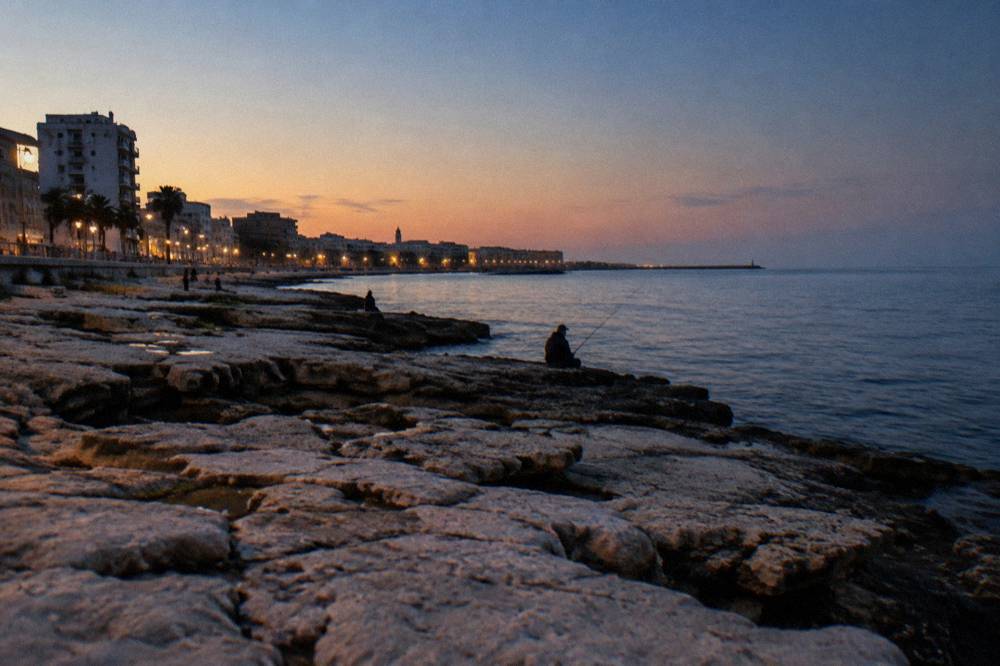
Start at Piazza del Ferrarese or Piazza Mercantile in Bari Vecchia, drop to the sea at the Muraglia and the old port of Molo San Nicola, then follow the Lungomare Nazario Sauro south past the Pinacoteca towards Madonnella, continuing until the shore opens out at Pane e Pomodoro, about 2.1 km from Piazza Mercantile by road. The whole line is public pavement and tram-free.
The first stretch is the most crowded and the most photographed. Piazza del Ferrarese, where the tourist information point is reported at number 29, marks the seam between the old town and the modern city; from there the lanes of Bari Vecchia drop towards the water. Strada Arco Basso is one of those lanes, known for its pasta makers; orecchiette is the pasta shape of Puglia, and the shops along the street sell it dried by the kilo. No source gives the days or hours at which the makers work at the street door, so treat any sighting as a bonus rather than a schedule.
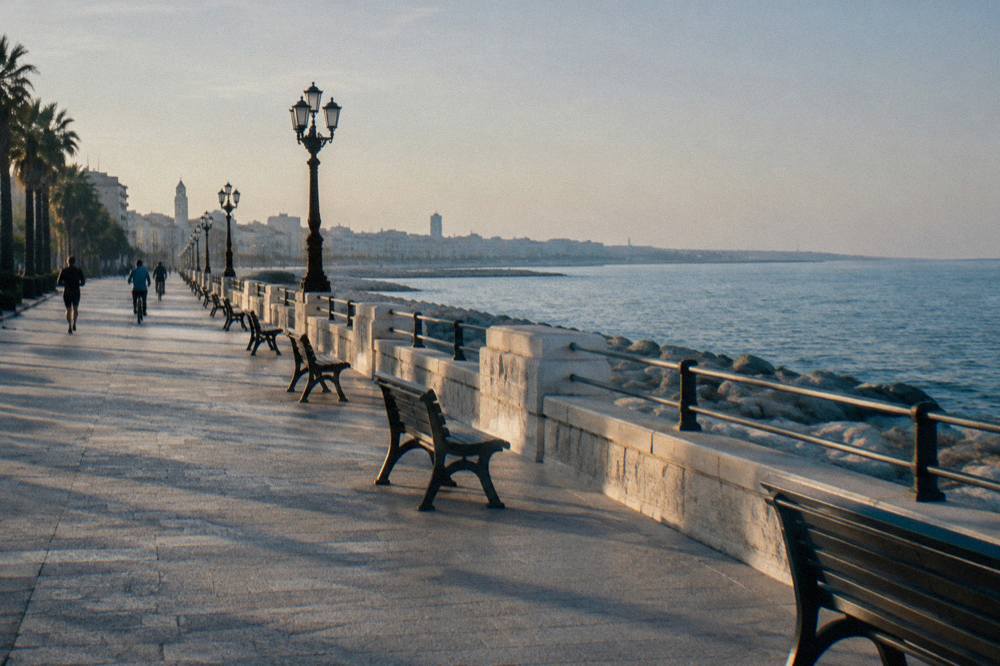
At the water's edge the walk turns formal. The Teatro Margherita, a theatre standing over the sea on piles, sits at the start of the Lungomare proper; the Teatro Margherita page covers the building itself. From there the promenade runs straight, the sea on one side, the museums and the edge of Murat on the other, until Madonnella and the beaches beyond.
The promenade is flat, paved and open at all hours as a public street. For the return, AMTAB city buses run along the waterfront roads: a single ticket costs 1.00 EUR, a 90-minute ticket 1.20 EUR and a day ticket 2.50 EUR per the AMTAB fares page. Note one caveat if you are relying on buses along the seafront: some Lungomare stops are subject to service changes while preparatory works are under way, and the operator posts the current stop situation on its own site.
What Can You See Along The Lungomare Nazario Sauro In Bari?
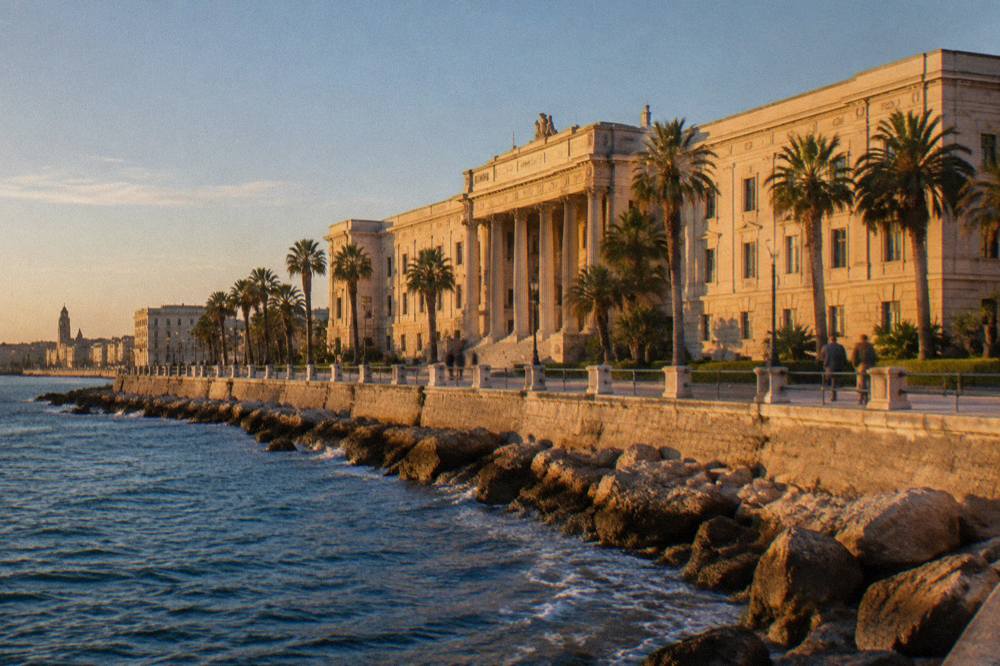
The sights on or beside the Lungomare Nazario Sauro include the old port of Molo San Nicola, the Pinacoteca Metropolitana Corrado Giaquinto at 5 EUR, the sea-facing stretch past Madonnella, and, at the far end, Pane e Pomodoro beach. The Basilica di San Nicola and the Castello Normanno-Svevo sit a few streets inland in Bari Vecchia.
The old port is the living part of the walk. Molo San Nicola is the quay where the fishing fleet ties up and the raw-fish trade of the city has its home; the Bari seafood and raw fish guide explains what ricci and frutti di mare mean on a Bari table. No official source publishes the market's days, hours or prices, so go expecting a working quay rather than a scheduled attraction. The Fortino di Sant'Antonio Abate, the small fort out on the water, closes the old-port picture on the sea side.
Inland, but within a short stroll of the promenade, the big two of Bari Vecchia wait. The Basilica di San Nicola is open Monday to Saturday 06:30 to 20:30 and Sunday 06:30 to 22:00, with no admission fee mentioned on its page, and it holds the relics of Saint Nicholas, brought from Myra by sailors in 1087 and placed in the crypt in 1089. The Swabian castle, the Castello Normanno-Svevo, costs 10 EUR full and 2 EUR reduced, Tuesday to Sunday 09:00 to 19:00, with Sunday openings of 09:00 to 13:30 from October to March except the first Sunday of the month. The basilica guide and the castle guide carry both in full.
The museums question is the one worth a table, because two of the three seafront-adjacent museums publish exact hours and prices and the hours differ by day.
| Museum or site | Hours | Ticket |
|---|---|---|
| Castello Normanno-Svevo | Tuesday to Sunday 09:00 to 19:00; October to March Sundays 09:00 to 13:30, except first Sunday 09:00 to 19:00 | 10 EUR full, 2 EUR reduced |
| Pinacoteca Metropolitana Corrado Giaquinto | Tuesday to Saturday 09:00 to 19:00, last entry 18:30; Sunday 09:00 to 13:00, last entry 12:30; closed Monday, 1 January, 8 May | 5 EUR full, 2 EUR reduced, 8 EUR combined |
| Museo Archeologico di Santa Scolastica | Tuesday to Saturday 09:00 to 19:00, last entry 18:30; Sunday and holidays from 09:00 | 5 EUR full, 2 EUR reduced ages 18 to 25, combined ticket with the Pinacoteca |
| Teatro Petruzzelli guided tours | Dated slots published monthly; box office opens 30 minutes before | 7 EUR full, 2 EUR reduced |
Two further details from the ticket pages. The Puglia Musei Card costs 20 EUR and covers all the Direzione regionale Musei Puglia sites, including the castle, for six months. And the state museums, the castle among them, have been listed for free entry on the first Sunday of the month under the Domenica al Museo scheme, reported in the regional press for October 2026, so time a first-Sunday visit if the calendar allows.
The seafront also works as a departure point for tours. In the city itself the old town rickshaw tour covers Bari Vecchia from the Lungomare edge, and you can Check availability on the operator's live listing; the broader picks below are the ones that pair best with a waterfront day.
The first of those three boards at Polignano a Mare, not in Bari: the boats leave from the coast town 37.4 km away by road, so it is a day trip with a transfer, not a Bari-waterfront cruise. For a boat that does leave from Bari's own port area, the city cruise products listed in the things to do in Bari overview run from the Bari waterfront.
Is The Lungomare Nazario Sauro A Swimming Beach In Bari?
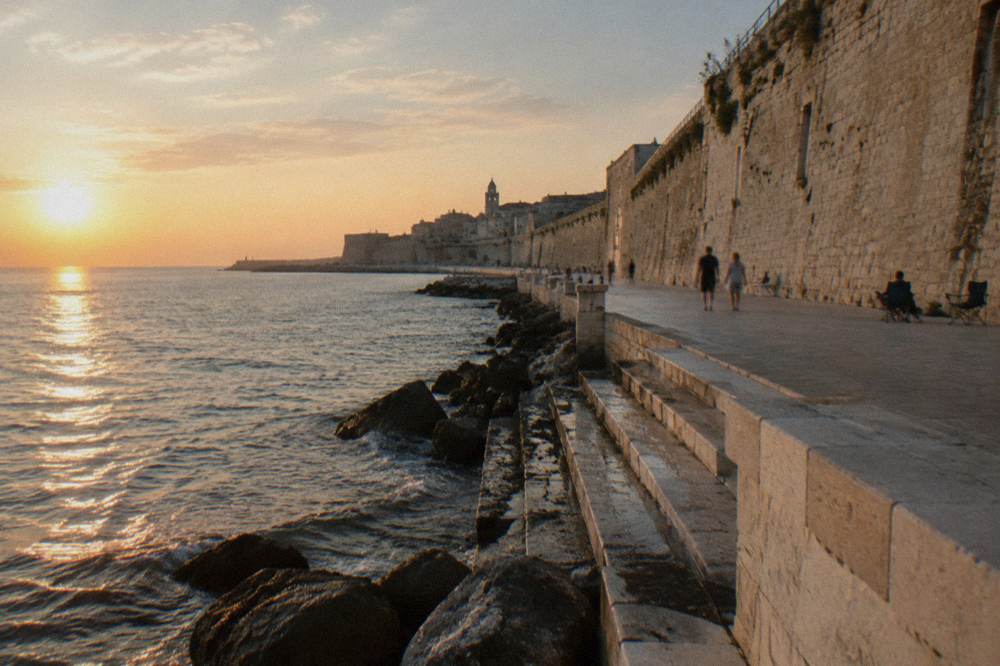
No. The Lungomare Nazario Sauro is a promenade, not a designated swimming beach, and Bari itself holds no Blue Flag beach in 2026. The city's beaches are separate stretches: Pane e Pomodoro about 2.1 km south of Piazza Mercantile, Torre Quetta about 3.9 km, and San Girolamo about 4.3 km to the north-west. The 2026 Blue Flags in the Province of Bari are at Polignano a Mare and Monopoli.
That Blue Flag point is where careful guides differ from careless ones. The region of Puglia earned 27 flags in 2026, and within the Province of Bari only Polignano a Mare and Monopoli carry one; Ostuni, Fasano and Carovigno fly theirs in the Province of Brindisi. None of that reflects on the water quality off the city itself: ARPA Puglia reports that the region ranked first in Italy for bathing water for the sixth consecutive year with 99.9 percent of waters classed excellent, and 78 bathing waters are monitored in the province of Bari. No rating is published for any individual named Bari beach, so none is claimed here.
Pane e Pomodoro, the beach at the southern end of the waterfront walk, is covered in full on the Pane e Pomodoro beach page. Facilities and charges at the city beaches vary by season, and reports of works affecting Torre Quetta in 2026 are exactly that, reports: confirm locally what is open before you plan a beach afternoon around it.
What the sea off the promenade is for, reliably, is looking at. The port of Bari is a working Adriatic hub, and the ship traffic is part of the promenade's free theatre.
| City beach | Direction from Piazza Mercantile | Distance |
|---|---|---|
| Pane e Pomodoro | South, in Japigia | about 2.1 km |
| Torre Quetta | South, in Japigia | about 3.9 km |
| San Girolamo | North-west | about 4.3 km |
What Is The Weather Like On The Bari Seafront?
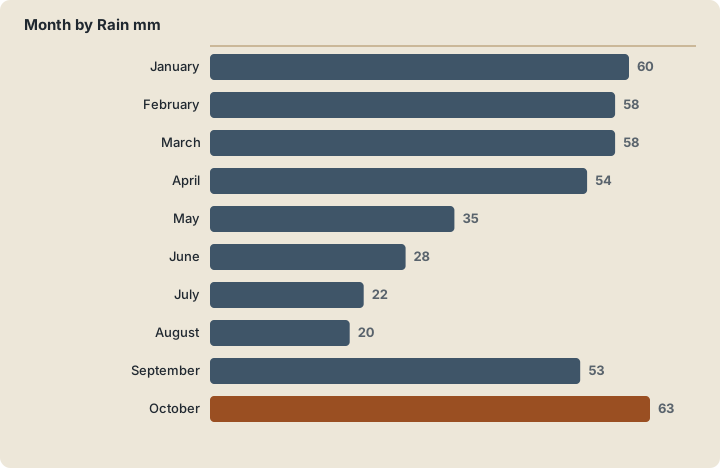
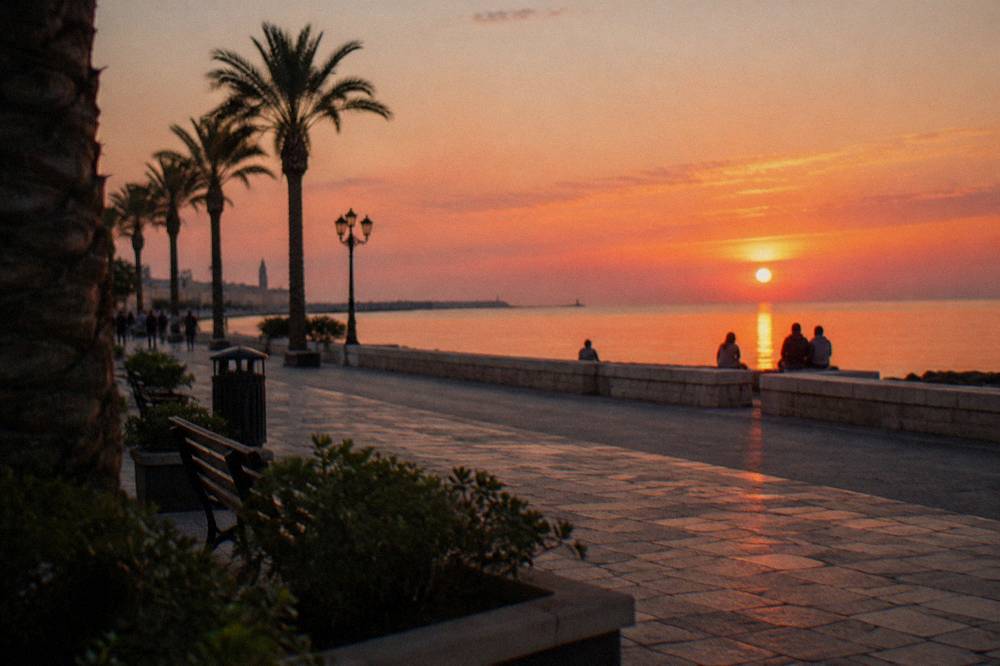
Typical values from modelled ERA5 data, 1991 to 2020, put Bari's July mean daily maximum at 28.6 C and August at 29.1 C, with January and February highs near 12 C, and about 587 mm of rain across the year, of which November carries 73 mm and August 20 mm. July and August average about 4 rain days each. The promenade itself adds sea breeze to those figures.
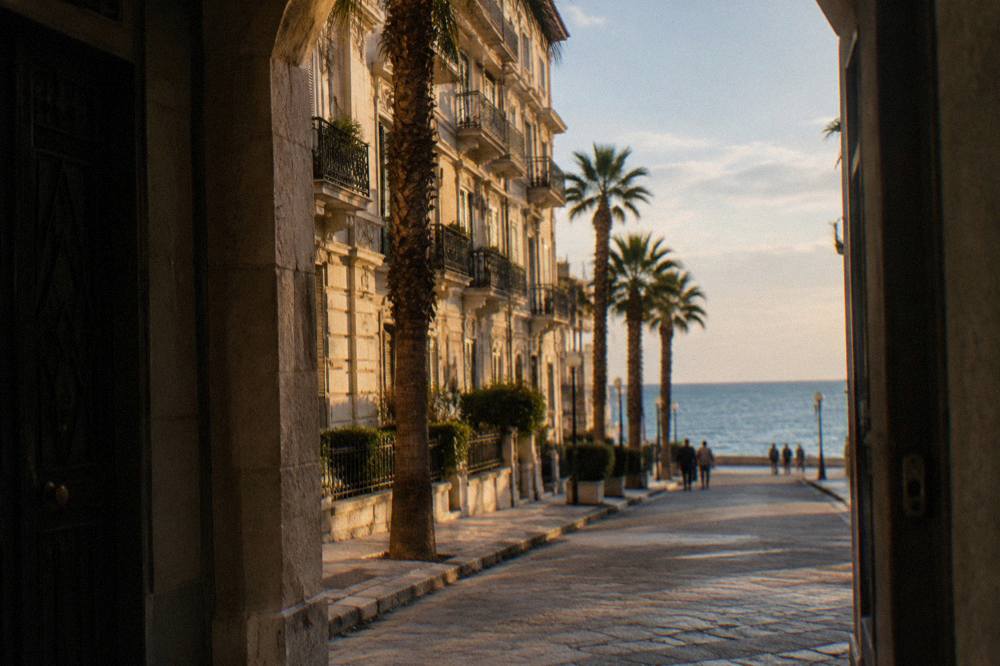
The practical reading of the table is this: the seafront walk is a summer-evening place in July and August, when the mean daily high touches 29.1 C and the rain days are fewest, and a mild-winter walk the rest of the year, since even January averages a high of 12.1 C. October and November are the months to pack a layer for the water side; November's 73 mm is the largest monthly total in the table, against August's 20 mm.
Sea temperature, as a modelled range from 2023 to 2025 means, runs about 27 C in July and August, about 22 C in October and about 14 C in February. Those figures describe the water off the coast generally, not a swimming verdict for any named city beach. Full month-by-month detail, and the packing logic that follows from it, sits on the best time to visit Bari page.
| Month | High C | Low C | Rain mm |
|---|---|---|---|
| January | 12.1 | 7.3 | 60.0 |
| February | 12.5 | 7.2 | 58.0 |
| March | 14.7 | 8.8 | 58.0 |
| April | 17.5 | 11.2 | 54.0 |
| May | 21.6 | 15.3 | 35.0 |
| June | 25.9 | 19.5 | 28.0 |
| July | 28.6 | 22.0 | 22.0 |
| August | 29.1 | 22.4 | 20.0 |
| September | 25.1 | 19.1 | 53.0 |
| October | 21.1 | 15.6 | 63.0 |
| November | 16.9 | 12.0 | 73.0 |
| December | 13.2 | 8.7 | 63.0 |
How Do Ferries And Cruise Ships Fit Into The Bari Waterfront?
The Stazione Marittima at Molo San Vito, about 0.5 km from Piazza Mercantile, is where the international ferries and cruise ships of the port of Bari berth. Adria Ferries sails to Durres every day all year in about 8 hours, GNV also sells Bari to Durres with a crossing reported at 10 hours 45 minutes, and Superfast's 2026 brochure lists the route Bari, Corfu, Igoumenitsa, Patras.
The port authority, the Autorita di Sistema Portuale del Mare Adriatico Meridionale, runs the terminal; GNV's port address is Varco della Vittoria, Lungomare Starita 6, with its ticket office on the Colmata di Marisabella. One crossing needs a caveat in print: Jadrolinija's Dubrovnik to Bari line 54 is seasonal and was reported interrupted for technical reasons in autumn 2026, so confirm on the operator's own site that the line is running before you plan around it, and check the current price on the operator's page before booking any ferry.
Cruise traffic gives the promenade its occasional giants. The port authority reported about 430,000 cruise passengers and 152 calls at Bari in the first nine months of 2025, up 21 percent, and it publishes the full 2026 cruise calendar as a PDF on its own site, which is where a ship-spotter or an arriving passenger should look for exact calls. The Bari airport to city centre page covers the airport arrival, the 17-minute Ferrotramviaria train from Karol Wojtyla airport at 5.30 EUR a single.
| Operator | Route from Bari | Notes |
|---|---|---|
| Adria Ferries | Durres | Every day, all year, about 8 hours |
| GNV | Durres | Crossing reported at 10 hours 45 minutes; terminal at Varco della Vittoria, Lungomare Starita 6 |
| Superfast | Corfu, Igoumenitsa, Patras | Route listed in the 2026 brochure; Corfu calls seasonal per a report |
| Jadrolinija | Dubrovnik | Line 54, seasonal; reported interrupted in autumn 2026, confirm before planning |
Which Events Bring The Bari Seafront To Life?
The Festa di San Nicola, Bari's patronal feast, runs 7 to 9 May each year, with the 2026 corteo storico setting off at 20:00 on 7 May from piazza Federico II di Svevia beside the castle, and the sea procession and the manna following on 8 and 9 May. The Bif&st film festival began its 17th edition on 21 March 2026, and the Fiera del Levante closed later in 2026.
The May feast is the one that uses the water. The sea procession on 8 May and the extraction of the manna on 9 May are part of the traditional programme, reported on the comune's pages, and the whole old port becomes the stage; the Bari San Nicola festival guide and the history of Bari and Saint Nicholas carry the story, including the translation of the relics from Myra in 1087. The 2027 programme had not been announced, so plan on the fixed early-May window rather than on published events. The feast fills the old town, and the question of whether the old lanes are worth the crowds is answered on the is Bari old town worth visiting page.
| Event | Timing | Source |
|---|---|---|
| Festa di San Nicola | Early May, 7 to 9 May | Annual by tradition; 2026 programme confirmed |
| Bif&st film festival | Late March | 17th edition from 21 March 2026 |
| Teatro Petruzzelli season | Autumn onwards | Il Trovatore reported opening 18 October 2026 |
Which Day Trips And Tours Pair Well With A Bari Seafront Day?
The best pairings are the Polignano a Mare cave boats, which depart from Polignano itself 37.4 km south by road, the Alberobello-and-Matera day tours, which reach two UNESCO World Heritage sites in one outing, and the city tours that start on the Bari waterfront, such as the old town rickshaw ride. Monopoli, Trani and Giovinazzo extend the same Adriatic coast by train or car.
Be precise about origins, because it changes your planning. The related pick for this page, a cave boat tour with aperitif, boards at Polignano a Mare; it is described on the cave boat tour page and you can Check availability on the operator's live listing. The same rule applies to the bigger day tours: the UNESCO Matera and Alberobello tour below departs from Alberobello, so read the listing's meeting point carefully. Remember too that Matera is in Basilicata, not Puglia; the day trip crosses a regional border, which is part of its appeal.
Closer to home, the coast runs in both directions. Monopoli, 47.3 km away by road and one of the Province of Bari's two Blue Flag towns, is covered on the Monopoli page; Giovinazzo, 21.7 km to the north-west, on the Giovinazzo page. Inland options from the same base include the Grotte di Castellana, whose full 3 km route costs 25 EUR for ages 15 and over and the partial 1 km route 22 EUR, and whose worth is weighed on the is Grotte di Castellana worth visiting page.
For a second or third day built around the waterfront, the two days in Bari itinerary and the Lungomare and Madonnella area guide sequence the same sights into full days, and the Bari Vecchia area guide covers the headland at the start of the walk.
Common Questions About The Lungomare Nazario Sauro In Bari
Is the Lungomare Nazario Sauro in Bari free?
Yes. The promenade is a public street with no ticket, no gate and no opening hours. The paid sights sit beside it: the Pinacoteca at 5 EUR, the Museo Archeologico di Santa Scolastica at 5 EUR and the Castello Normanno-Svevo at 10 EUR full.
Can you swim from the Lungomare Nazario Sauro?
The Lungomare is a promenade, not a designated swimming beach. The city beaches are separate stretches at Pane e Pomodoro, about 2.1 km from Piazza Mercantile, Torre Quetta about 3.9 km, and San Girolamo about 4.3 km north-west.
Does Bari have a Blue Flag beach?
Not in 2026. The Blue Flags in the Province of Bari are at Polignano a Mare and Monopoli. Regionally, Puglia earned 27 flags and ARPA Puglia reports 99.9 percent of its bathing waters classed excellent, sixth year first in Italy.
How do you get to the Lungomare from Bari Centrale?
AMTAB city buses connect Bari Centrale with the seafront, with a single ticket at 1.00 EUR, a 90-minute ticket at 1.20 EUR and a day ticket at 2.50 EUR. Some waterfront stops are subject to service changes during works, and the operator posts the current situation.
How far is the walk from the old port to Pane e Pomodoro?
Pane e Pomodoro lies about 2.1 km from Piazza Mercantile by road, at the southern end of the waterfront. The Stazione Marittima at Molo San Vito is about 0.5 km from Piazza Mercantile, so the whole line from ferry terminal to beach fits in one continuous walk.
Do ferries and cruise ships leave from the Lungomare?
The Stazione Marittima at Molo San Vito, about 0.5 km from Piazza Mercantile, is the ferry and cruise terminal. Adria Ferries sails to Durres daily year-round in about 8 hours, GNV also serves Durres, and Superfast lists Corfu, Igoumenitsa and Patras in its 2026 brochure. Jadrolinija's Dubrovnik line was reported interrupted in autumn 2026, so confirm it is operating before planning.
The Lungomare Nazario Sauro is the one part of Bari where the whole city is visible in a single line: the old port and the basilica's towers at the start, the museums and theatres in the middle, the beaches and the Adriatic horizon at the end. Walk it once in the morning for the light on the water and once after dark in summer, when the mean August high of 29.1 C has finally dropped, and the promenade does the rest on its own.