Panzerotti In Bari: Fried, Baked And Where To Order
Panzerotti are the pocket of fried dough that Bari, capital of Puglia in southern Italy, has turned into its signature street food. This guide sets out what a panzerotto is, how the fried and baked versions differ, how the dish sits beside orecchiette and focaccia barese, and how to taste your way through it.
Short answer
A panzerotto in Bari is a small pocket of dough sealed around a filling, classically tomato and mozzarella, and either deep fried until blistered or baked. It is street food, eaten hot from the paper bag, and it sits beside orecchiette and focaccia barese as one of the three dishes the city is known for.
Panzerotti are the hand-sized pockets of dough that Bari, the capital of Puglia on the Adriatic coast of southern Italy, fries and sells by the paper bag. The city's food identity is built on three dishes: orecchiette pasta, focaccia barese and panzerotti, and this page is about the third one, the one designed to be eaten standing up, in the street, while it is still too hot to hold comfortably.
What Is A Panzerotto In Bari?
A panzerotto is a small half-moon of dough folded around a filling, sealed at the edge and cooked until the crust blisters, and in Bari it is above all street food, sold hot and eaten out of hand. The classic filling is tomato and mozzarella, though the city's counters offer other stuffings too. The singular is panzerotto, the plural panzerotti, and the word refers to the fried or baked pocket, not to any filled pasta.
That single plain sentence is about all that can be said with certainty about the dish itself. What a panzerotto is not: it is not a calzone, which is a larger oven-baked folded pizza, and it is not a fritto, the mixed fried seafood that Bari's raw-fish counters serve. The panzerotto is its own thing, smaller than a calzone, and the frying is the point for the classic version: the dough puffs, the crust goes glassy in patches, and the tomato filling arrives at a temperature that demands respect.
The dish belongs to Bari's street-food culture, which is one of the reasons the city has built a food-tour economy around it. Bari Vecchia, the old town on the headland between the old port and the Murat grid, is where that culture is densest: the lanes around Strada Arco Basso, the street known for its pasta makers, and the squares Piazza Mercantile and Piazza del Ferrarese are all within a few minutes' walk of each other, and a food walk through them covers panzerotti, focaccia barese, sgagliozze, which is fried polenta, and raw seafood in one loop. The Bari street food guide covers that loop in detail.
No bakery, shop or stall name appears on this page, and no ranking of counters either. What the sources support is the dish and its context; the choice of where to order is best made by walking, following the smell of frying dough, and checking the posted prices before you order.
Fried Or Baked: Which Panzerotto Should You Order In Bari?
The fried panzerotto is the classic: submerged in hot oil until the crust blisters and the pocket inflates, giving a glossy, tender-crunchy shell. The baked version is the lighter alternative, cooked in an oven like a folded pizza, with a drier, bread-like crust. Both carry the same tomato and mozzarella filling, and both are sold in Bari, so the choice is between a richer street snack and a lighter one.
The fried version is the one that made the dish famous, and it is the one to try first if you are eating it once. Frying does two things to the dough that an oven cannot: it cooks the outside fast enough to seal it before the filling floods out, and it leaves the crust with the blistered, almost transparent spots that show the oil did its work. The result is greasy in the way good fried bread is greasy, which is to say you notice it on your fingers and forgive it immediately.
The baked panzerotto, sometimes marked al forno on a counter card, skips the oil bath entirely. The crust comes out closer to focaccia barese in texture, the filling stays contained, and the whole thing travels better if you are carrying lunch to the Lungomare Nazario Sauro or the city beaches at Pane e Pomodoro. Baked is also the safer order in high summer, when the thought of fried food at the July mean daily maximum of 28.6 C, a typical value from modelled ERA5 data 1991 to 2020, can test a visitor's resolve.
The table sums up the two versions side by side.
| Version | How it is cooked | Crust | Filling | Best moment |
|---|---|---|---|---|
| Panzerotto fritto | Submerged in hot oil | Blistered, glossy, tender-crunchy | Tomato and mozzarella, classically | Eaten standing, straight from the fryer |
| Panzerotto al forno | Oven baked | Dry, bread-like, close to focaccia | Same, plus vegetable fillings | Carrying to the seafront or a picnic |
Prices vary from counter to counter, and the posted price at the till is the one that counts. Check it before you order, as you would anywhere in Italy, and check the itemised bill at a sit-down place.
If eating panzerotti cold from a bag feels like half the experience, a cooking class is the other half. The class below covers Bari's pasta and dessert traditions in a small group, and dough work of exactly the kind that produces panzerotti is part of the city's home-cooking repertoire.
Where To Order Panzerotti In Bari?
The honest answer is that the workable strategy is geographic: work the old town, Bari Vecchia, and the edges of the Murat district, where the counters are densest, and order where you see dough being folded and fried in front of you. Piazza Mercantile, Piazza del Ferrarese and the streets around Strada Arco Basso put you inside a five-minute walk of several options.
Bari Vecchia is the obvious hunting ground. The old town is compact, roughly a peninsula of lanes between the Swabian castle and the old port at Molo San Nicola, and its food counters cluster along the routes visitors naturally walk: from the Castello Normanno-Svevo down Strada Arco Basso toward the Basilica di San Nicola, and along Piazza Mercantile and Piazza del Ferrarese, which sit at the seam between the old town and the Murat grid. The tourist information point is at Piazza del Ferrarese 29, which makes that square a natural first stop for maps and questions.
The Murat district, the grid of streets around Via Sparano that runs south of the old town, holds the more modern takeaway counters and the chains, and it is where the city's shopping streets guide your walk anyway. For the full picture of that district, see the Bari street food guide and the things to do in Bari overview.
Three practical rules make the search easier. First, order where you can see the frying: a panzerotto made ahead and reheated is a different, sadder object. Second, check the posted price before ordering, since counters vary and nothing here can quote one. Third, eat it there: the fried version has a useful life measured in minutes, and the walk to the seafront, about 2.1 km from Piazza Mercantile to Pane e Pomodoro, is best done after the bag is empty.
| Area of Bari | What it offers for panzerotti hunters | Walking anchor |
|---|---|---|
| Bari Vecchia lanes | Old-town counters, densest cluster, folding and frying in view | Strada Arco Basso to Piazza Mercantile |
| Piazza del Ferrarese and Piazza Mercantile | Squares at the old town seam, with the tourist info point at number 29 | Between old town and Murat |
| Murat district | Modern takeaway counters around the shopping grid | Via Sparano |
| Seafront and beaches | Eating en route to Pane e Pomodoro, 2.1 km from Piazza Mercantile | Lungomare Nazario Sauro |
The cooking class below is the closest thing to a guaranteed panzerotti experience in the city, because the dough, the sealing and the filling all happen in front of you, with a cook explaining each step.
How Do Panzerotti Compare With Bari's Other Street Food?
Panzerotti sit in a trio of Bari street dishes that also includes focaccia barese, the oily tomato-topped flatbread, and sgagliozze, fried squares of polenta, with raw seafood at the fish counters as the fourth pillar. Panzerotti are the only one of the three built around a sealed filling, which makes them the most portable and the most filling per bite. Each dish has its own page in this guide.
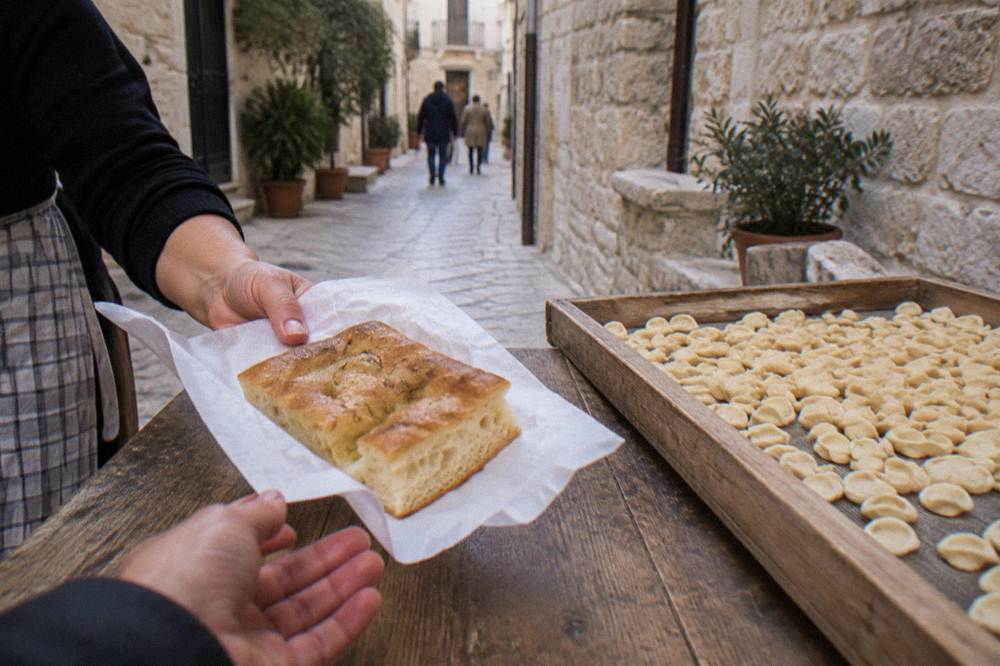
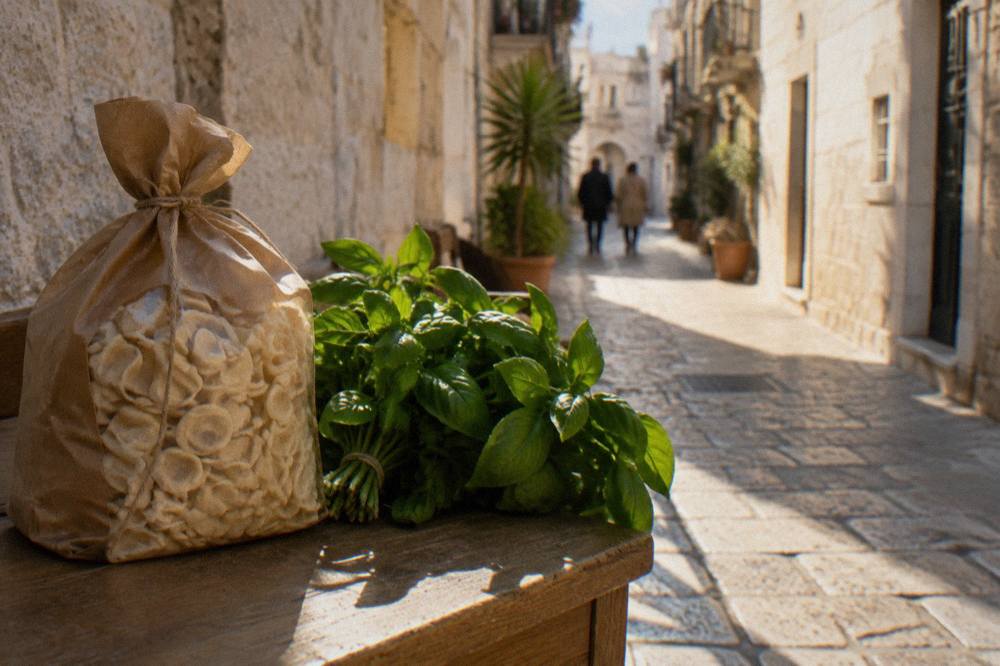
Orecchiette is the exception in this group because it is not street food at all: it is the pasta shape of Puglia, "little ears" of hand-rolled durum dough, and in Bari it is a plate dish, classically with cime di rapa turnip tops. It belongs to the same home-cooking tradition that produces panzerotti dough, and the two often share a counter and a cook, but they answer different questions: orecchiette is lunch, panzerotti are a snack. The orecchiette in Bari guide covers the pasta in full.
Focaccia barese is the closest relative. It is a shallow, oily flatbread baked with cherry tomatoes and olives on top, and the dough family it belongs to overlaps with panzerotto dough in flour, water and technique. The focaccia barese guide covers it. Sgagliozze, fried polenta squares sprinkled with salt, are the old-town counters' other fried offering, and raw seafood, including ricci sea urchins, is what the Molo San Nicola fish market area is known for, though no market days, hours or prices can be stated here.
| Bari dish | What it is, in one line | Where it sits | Eat it when |
|---|---|---|---|
| Panzerotto | Sealed pocket of dough, fried or baked, tomato and mozzarella inside | Street food, eaten by hand | Mid-morning or evening walk |
| Focaccia barese | Oily flatbread baked with tomatoes and olives on top | Bakery counter, cut to order | Breakfast or mid-morning |
| Sgagliozze | Fried squares of polenta, salted | Old town street counters | Afternoon snack |
| Orecchiette | Hand-rolled ear-shaped pasta, a plate dish with cime di rapa | trattoria kitchens, home cooking | Lunch or dinner |
| Raw seafood and ricci | Sea urchins and shellfish served raw | Fish counter culture near Molo San Nicola | With a seated order |
A street food tour is the efficient way to sample several of these in one walk, with a local guide choosing the counters. The tour below covers the city's street-food canon, and its live listing carries the current price, meeting point and availability.
You can read more about that walk on the ultimate street food tour page, and if the counter crawl appeals, the wider Bari restaurants guide covers where street food ends and the sit-down city begins.
Can You Learn To Make Panzerotti In A Bari Cooking Class?
Yes. Bari cooking classes teach the city's dough and pasta traditions in small-group home kitchens, and the dough work behind panzerotti, mixing, resting, filling and sealing, is part of the same repertoire as orecchiette and focaccia. Classes listed on this site are offered in English where the product block says so, and their prices, durations and ratings render from the live listing rather than being quoted here.
The value of a class over a counter visit is that you see the technique. Sealing a panzerotto so the filling survives the oil, rolling orecchiette with a knife edge the way Bari's pasta makers do, and dressing focaccia barese at the right moment are all hand skills, and a class is where a local cook corrects yours. The related tour on this page, the Cesarine small-group pasta class, is the featured pick for exactly this reason: it covers pasta and tiramisu in one session, and tiramisu is the dessert half of the city's home-cooking shortlist.
| Format | What it covers | Who it suits |
|---|---|---|
| Pasta and tiramisu class | Hand-rolled pasta technique plus a dessert, in a small group | First-time visitors wanting one class |
| Pasta class with orecchiette focus | The ear-shaped pasta, dough to sauce | Cooks who want the signature dish |
| Street food walking tour | Tasting across several counters with a guide | Visitors who prefer eating to cooking |
| Bike tour with tasting | The old town loop with a food stop | Active visitors, families with older children |
Check availability for the featured class at the operator's live listing, since dates and group sizes change with the season.
When Is The Best Season For Eating Your Way Around Bari?
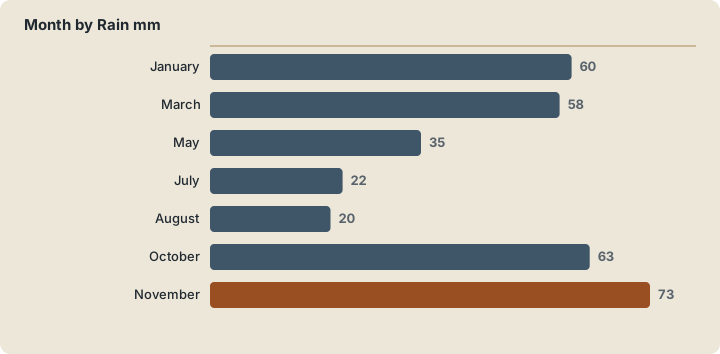
Late spring and early autumn are the comfortable seasons for a street-food walk in Bari. The climate table shows May with a high of 21.6 C and 35 mm of rain, September at 25.1 C and 53 mm. July and August, with highs of 28.6 C and 29.1 C and about 22 mm and 20 mm of rain, are hot and dry. All figures are typical values from modelled ERA5 data, 1991 to 2020.
Winter is not a barrier to panzerotti either: January and February highs sit around 12 C, and fried food is precisely what that weather calls for. The differences across the year are real but not dramatic on the rain side, about 587 mm annually, with November at 73 mm the month with the highest total and August at 20 mm the lowest. What changes more is the city itself: early May brings the Festa di San Nicola, the patronal feast on 7 to 9 May by tradition, which fills Bari Vecchia with processions and stalls, while the summer months push daily life toward the seafront and the beaches.
| Month | Mean daily high C | Rain mm | Rain days | Street-food verdict |
|---|---|---|---|---|
| January | 12.1 | 60.0 | 9.5 | Fried food weather, quiet lanes |
| March | 14.7 | 58.0 | 9.4 | Mild, unsettled, thin crowds |
| May | 21.6 | 35.0 | 6.9 | Feast days 7 to 9 May, ideal walking |
| July | 28.6 | 22.0 | 4.1 | Hot and dry, eat early, head to the sea |
| August | 29.1 | 20.0 | 4.3 | Peak heat, sea at about 27 C |
| October | 21.1 | 63.0 | 7.9 | Warm days, autumn rain returning |
| November | 16.9 | 73.0 | 8.9 | Highest monthly rain total, indoor eating |
For the full month-by-month picture and the season-by-season trade-offs, the Bari weather guide and the best time to visit Bari guide carry the complete climate table and the events calendar.
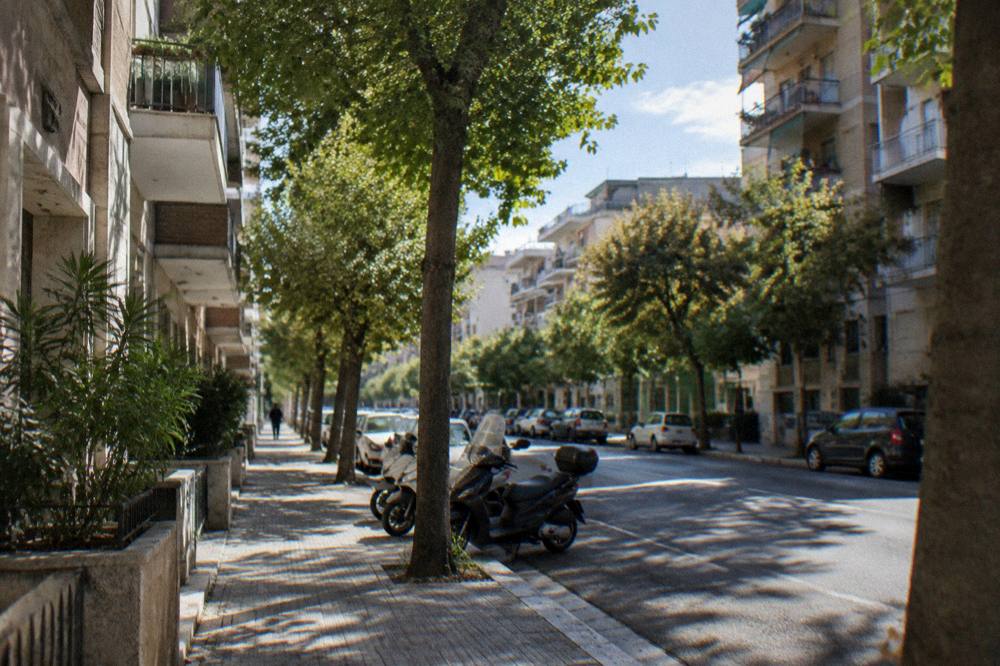
How Do Panzerotti Fit Into A Day In Bari?
A realistic panzerotti day in Bari runs: morning in Bari Vecchia around the Basilica di San Nicola and the Swabian castle, a mid-morning panzerotto and focaccia barese stop near Piazza Mercantile, an afternoon along the Lungomare Nazario Sauro to Pane e Pomodoro beach 2.1 km away, and dinner on orecchiette in a trattoria. The fried pocket is the connective snack between those anchors, not a meal in itself.
The geography makes this easy. The Basilica di San Nicola is open Monday to Saturday 06:30 to 20:30 and Sunday 06:30 to 22:00, with no admission fee mentioned on its page, so the morning church stop costs nothing but time. The Swabian castle costs 10 euro full and 2 euro reduced, open Tuesday to Sunday 09:00 to 19:00, and from October to March Sundays run 09:00 to 13:30 except the first Sunday of the month. Both sit within the same quarter as the panzerotti counters, so a single walk covers the sights and the snacks.
The afternoon options split three ways. The seafront walk along the Lungomare Nazario Sauro passes the Fortino toward Pane e Pomodoro, or you can turn inland to the Pinacoteca Metropolitana Corrado Giaquinto, open Tuesday to Saturday 09:00 to 19:00 with Sunday hours 09:00 to 13:00, at 5 euro full and 2 euro reduced. Families have a dedicated route in the Bari with kids guide, and one-day visitors can follow the one day in Bari plan.
| Time of day | Anchor | Cost where known |
|---|---|---|
| Morning | Basilica di San Nicola, then the Swabian castle | Basilica free, castle 10 euro full, 2 euro reduced |
| Mid-morning | Panzerotto and focaccia stop near Piazza Mercantile | Check the posted price at the counter |
| Afternoon | Lungomare walk to Pane e Pomodoro, or the Pinacoteca | Pinacoteca 5 euro full, 2 euro reduced |
| Evening | Orecchiette dinner in Bari Vecchia or Murat | Check the menu before sitting |
A guided walk stitches these anchors together with the food stops built in.
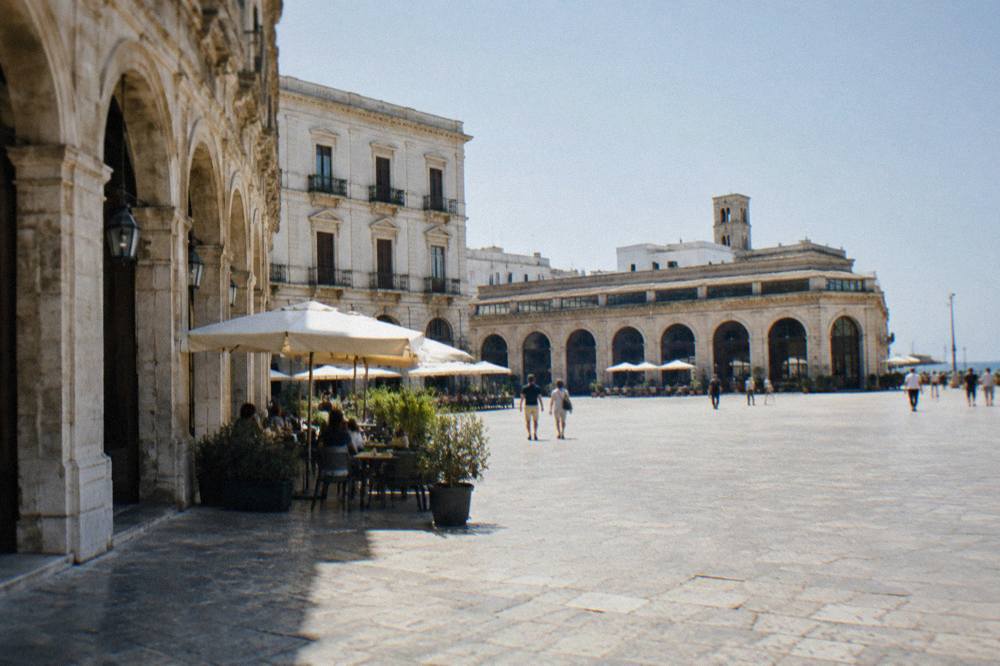
Can You Find Panzerotti Outside Bari On A Day Trip?
Panzerotti travel with you, not with the map: the dish is eaten across Puglia, but Bari is its home base, and the day-trip towns from Bari, Polignano a Mare at 37.4 km, Monopoli at 47.3 km and Alberobello at 56.7 km by road from Piazza Mercantile, each have their own food culture with their own counters. Polignano is 33 km by rail on the Trenitalia Bari-Lecce line, Monopoli 41 km, so both are quick trips for a half-day.
The point is not that panzerotti stop at the city line, but that a day trip is better spent on what the destination does distinctly. Polignano a Mare is the cliff-and-cave town, with boat tours of the caves leaving from Polignano itself, not from Bari. Alberobello is the trulli town, a UNESCO World Heritage site. Matera, about 70.8 km and 69 minutes by road from Piazza Mercantile, is the Sassi city, and it is in Basilicata, not Puglia, so the day trip crosses a regional border. Lecce, at 151.1 km by road, is the baroque far end of the region, a long day or an overnight.
| Day trip from Bari | Road distance from Piazza Mercantile | Drive time, free-flow | What the town is for |
|---|---|---|---|
| Polignano a Mare | 37.4 km | about 36 minutes | Cliffs, Lama Monachile, cave boats |
| Monopoli | 47.3 km | about 43 minutes | Old port town, Blue Flag 2026 |
| Alberobello | 56.7 km | about 61 minutes | Trulli, UNESCO World Heritage |
| Trani | 47.2 km | about 45 minutes | Cathedral by the sea, Swabian castle |
| Matera (Sassi) | 70.8 km | about 69 minutes | Sassi districts, in Basilicata |
| Lecce | 151.1 km | about 115 minutes | Baroque city, long day trip |
Each of those towns has its own guide on this site, from Polignano a Mare to Bari to Matera, and none of them requires you to give up panzerotti for the day: eat before the train, or on the way back in.
Before planning the wider circuit, it helps to fix how long to give the city itself, which the how many days in Bari guide settles.
If tasting and cooking your way through Bari in one visit is the plan, the three picks below are the ones this site features for food-first visitors: a pasta and tiramisu class, a street food walk with a local guide, and an underground archaeology tour for the hours between meals.
Common Questions About Panzerotti In Bari
What is a panzerotto in Bari?
A panzerotto is a small half-moon of dough sealed around a filling, classically tomato and mozzarella, and either deep fried until the crust blisters or baked. In Bari it is street food, sold hot and eaten by hand.
What is the difference between fried and baked panzerotti?
The fried version, the classic, is cooked in hot oil and has a blistered, glossy crust. The baked version is cooked in an oven and has a drier, bread-like crust closer to focaccia. The filling is the same in both.
Where can I order panzerotti in Bari?
Order where you can see the dough being folded and fried in front of you, and check the posted price at the till.
Are panzerotti the same as calzone?
No. A calzone is a larger oven-baked folded pizza served as a plate dish. A panzerotto is smaller, designed as street food, and the classic version is fried rather than baked.
Can I learn to make panzerotti in Bari?
Yes. Cooking classes in Bari teach the city's dough and pasta traditions in small groups, and the mixing, filling and sealing behind panzerotti belong to the same home-cooking repertoire as orecchiette and focaccia barese. Check availability on the operator's live listing before your trip.
What else should I eat in Bari besides panzerotti?
The city's shortlist runs orecchiette with cime di rapa, focaccia barese, sgagliozze fried polenta and raw seafood including ricci. Each has its own guide on this site, and a street food walking tour covers several in one loop of the old town.
The fried pocket is the smallest of Bari's three signature foods and the easiest to underestimate: it costs little, travels in a paper bag and is finished in five minutes, yet the dough work behind it is the same tradition that fills the city's kitchens and cooking classes. Eat it hot, order it where you can see the oil working, and if the taste sends you looking for the recipe, the counter to head for is a kitchen, not a bakery, as the Bari Italy Travel Guide lays out across its food pages.