What Is The Prettiest Town In Puglia?
Comparing the prettiest towns within reach of Bari, from Polignano a Mare's cliffs to Ostuni's white hillside, with distances, rail lines and entry fees from official sources.
Bari, the capital of the Puglia region on Italy's Adriatic coast, sits within an hour or two of a string of small towns whose looks drive the region's whole reputation. The question of which one is prettiest cannot be answered with a single name honestly, because the contenders fall into three distinct types: towns built over the sea, white hill towns of the Valle d'Itria, and grand limestone cities. What can be answered with real figures is how far each sits from Bari, what each costs to enter, and how the setting differs. That comparison, drawn from official museum pages and computed road distances, is what this page sets out. For the broader picture, the day trips from Bari overview lists the full set.
What Is The Prettiest Town In Puglia?
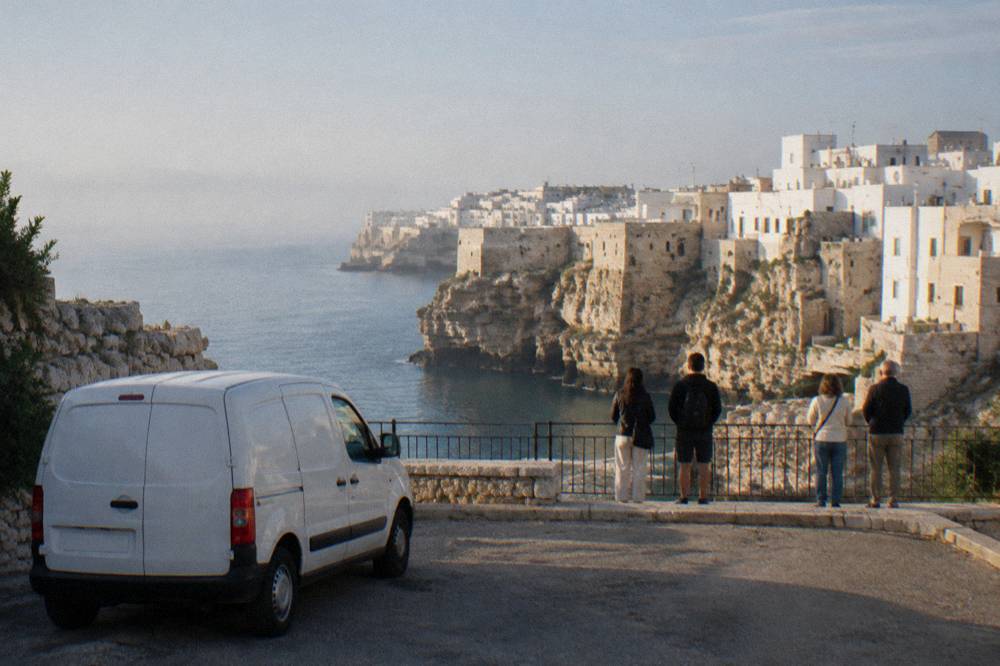
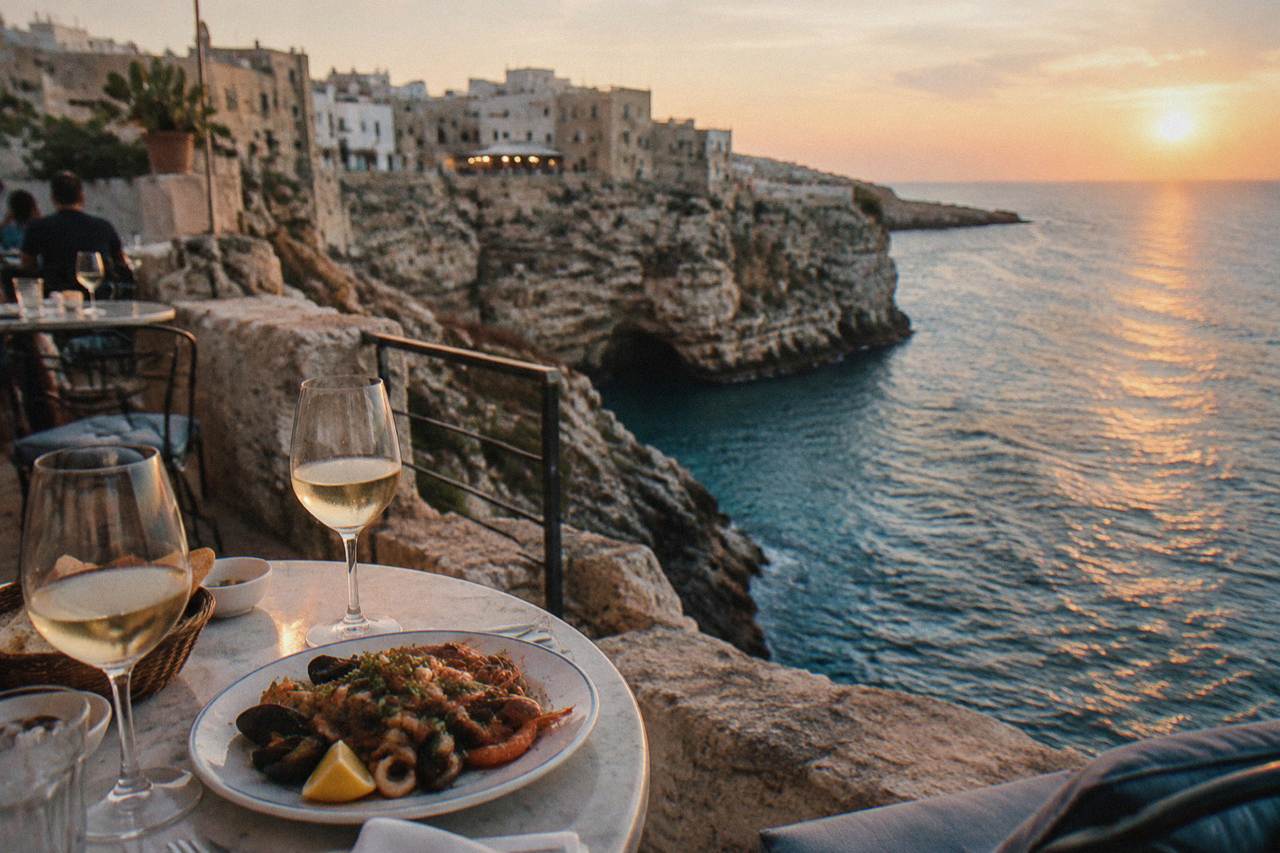
The name that answers this question first for the coast is Polignano a Mare, a town of houses stacked directly on limestone cliffs about 37 km and 36 minutes by road from Bari's Piazza Mercantile, with the cove of Lama Monachile between two rock walls. For a white hill town the answer is usually Ostuni or Locorotondo, and for a grand city setting it is Lecce, about 151 km from Bari, which makes it a long day or an overnight.
Editorially, there is no official ranking of prettiness, so the comparison has to run on setting and access. Polignano a Mare wins on drama: the town stands on a cliff edge above the Adriatic, its old centre is compact, and it is the closest of the famous towns to Bari, reachable on Trenitalia regional trains along the Bari-Lecce line, 33 km by rail, typically 25 to 35 minutes per secondary timetables, so confirm the timetable before you go. The town holds a Blue Flag for 2026, awarded by the Foundation for Environmental Education and confirmed by Regione Puglia, which says something about the water below those cliffs.
Ostuni, the so-called white town, argues its case with a hillside of whitewashed houses stacked below a cathedral skyline, 85.3 km and about 73 minutes by road from Bari. It sits in the Province of Brindisi, not the Province of Bari, and it too holds a Blue Flag for 2026. Locorotondo, in the Valle d'Itria, is the quieter candidate: a circular old centre of white lanes and balconied houses, 68.8 km from Bari by road, reachable through the Trenitalia and FSE Trulli Link service, with the FSE leg reported at 5.90 EUR on top of the rail fare, so confirm the fare with the operator.
Alberobello adds a category nothing else in the set can match: whole districts of trulli, the dry-stone cone-roofed houses listed by UNESCO as a World Heritage site, 56.7 km and about 61 minutes by road. Trani, on the coast north of Bari at 47.2 km and about 45 minutes, argues with a cathedral rising straight off the harbour water. Lecce is the baroque answer at the far end of the region.
Is Ostuni Or Locorotondo The Prettier Hill Town From Bari?
Ostuni is the bigger and more photographed of the two white towns, 85.3 km and about 73 minutes by road from Piazza Mercantile, while Locorotondo is smaller, quieter and closer at 68.8 km and about 58 minutes, so the choice comes down to scale versus calm. Ostuni also carries a 2026 Blue Flag for its coastal strip, which Locorotondo, an inland town, does not seek.
Ostuni's whole visual argument is the approach: a white town on a hill with a cathedral spire above it, visible for kilometres across olive plain. The olive country around it matters too, and farm visits among those groves, with olive oil tasting, are sold as tours from the area. Locorotondo's argument is density rather than spectacle: the old centre is a ring of white alleys, cummerse balconies and sudden valley views over the Valle d'Itria, and it is usually the calmer of the two to walk in. Cisternino, 77.0 km and about 67 minutes, is a third, smaller Valle d'Itria option in the same direction.
Practically, both are reachable by public transport, though not equally directly. Locorotondo is on the Trulli Link intermodal service from Bari, which combines a Trenitalia train with an FSE bus or train leg toward Alberobello and Martina Franca. Ostuni is on the Trenitalia Bari-Lecce line at 75 km by rail, but the station sits below the town, so allow for the climb or a taxi from the station. Check the operators' timetables for both, since services change during works.
How Do The Pretty Towns Compare On Distance And Cost From Bari?
Polignano a Mare is the closest famous town at 37.4 km and about 36 minutes by road, Monopoli and Trani sit near 47 km, Alberobello at 56.7 km and Locorotondo at 68.8 km fill the middle, and Ostuni at 85.3 km and Lecce at 151.1 km are the far reaches, with entry fees charged only at Alberobello-adjacent sights such as Castel del Monte at 10 EUR full and 2 EUR reduced.
The road distances below are free-flow figures computed from Piazza Mercantile in Bari Vecchia, the square at the heart of the old town. Rail distances follow the Trenitalia Bari-Lecce line where the card gives them.
| Town | Road distance from Bari | Drive time, free flow | Rail distance | Known entry cost |
|---|---|---|---|---|
| Monopoli | 47.3 km | about 43 min | 41 km | none stated |
| Trani | 47.2 km | about 45 min | not stated | Swabian castle 8 EUR, reduced 2 EUR |
| Alberobello | 56.7 km | about 61 min | via Trulli Link | none stated for the trulli districts |
| Locorotondo | 68.8 km | about 58 min | via Trulli Link | none stated |
| Ostuni | 85.3 km | about 73 min | 75 km | none stated |
| Lecce | 151.1 km | about 115 min | 150 km | none stated for churches |
Two cautions sit behind that table. No official point-to-point Trenitalia fare was found for any of these rail journeys, so check the operator's fare when you book rather than trusting a round number from an aggregator. And the drive times are free-flow estimates; summer weekends on the coastal road run longer. If you would rather not drive or decode four different operators, a guided bus tour that strings Alberobello, Monopoli and Polignano together in one day is the practical answer, and the Bari walk through history page explains the city-side counterpart for your Bari days.
Is Alberobello Worth It For The Looks Alone?
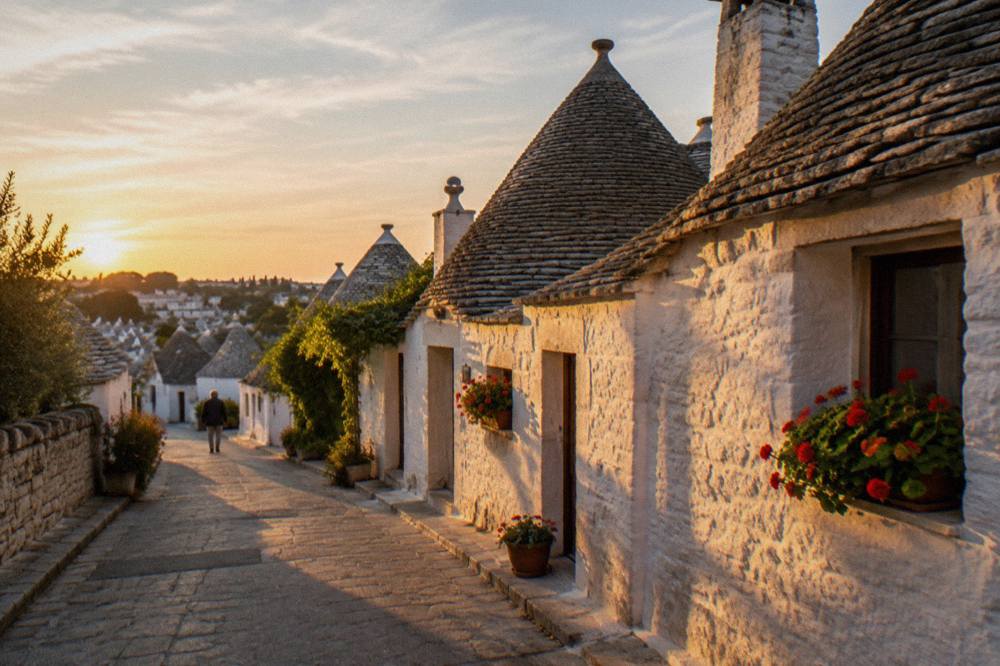
Alberobello is the only town in the comparison with UNESCO World Heritage status for its architecture, granted to the trulli districts, and it lies 56.7 km and about 61 minutes by road from Bari, so it is a genuine half-day trip with a setting no other town in the set can imitate. The trade-off is that the trulli districts are the region's single biggest draw and feel it in peak season.
The trulli are dry-stone buildings with conical roofs, and Alberobello holds entire districts of them, not scattered examples. That concentration is what the UNESCO listing recognises. No admission fee for the districts themselves was found on an official page, so walking them costs nothing but time, and no fee for Trullo Sovrano or a confirmed inscription year was found either; check the current price on the official ticket page before booking any individual trullo visit.
The usual pairing is Alberobello with Locorotondo or Martina Franca, 74.9 km and about 68 minutes by road, both in the Valle d'Itria and both reachable through the Trulli Link. If you are deciding between Alberobello and Polignano a Mare for a single day, the honest split is architecture against sea: cones against cliffs.
Is Bari Itself Pretty, Or Just The Day Trips?
Bari's own good looks sit in Bari Vecchia, the old town on the headland between the old port and the Murat grid, where the Basilica di San Nicola is open Monday to Saturday 06:30 to 20:30 and Sunday 06:30 to 22:00 with no admission fee mentioned on its page, and the Swabian castle charges 10 EUR full and 2 EUR reduced. The city is not a postcard hill town, but its old centre holds its own against any of the day-trip destinations.
Bari Vecchia gives you the tight pale-stone lanes, the sea walls of the Muraglia with the Adriatic below, the fish market activity at Molo San Nicola and the pasta makers of Strada Arco Basso, where orecchiette, the pasta shape of Puglia, is made by hand. Beyond the old town, the Lungomare Nazario Sauro runs along the water, and the Murat district's shopping grid around Via Sparano gives the city its orderly counterweight. The is Bari worth visiting page covers the fuller case, and the walkability of Bari page confirms how much of this you can cover on foot.
Two practical notes if Bari Vecchia tempts you into a stay. Do not drive into the old town: it is a limited traffic zone with a camera gate at the Castello since 1 July 2026, and the perimeter parking is paid on working days 08:30 to 20:30. And if you use the castle ticket wisely, the Puglia Musei Card covers all the Direzione regionale Musei Puglia sites, including the castle, for 6 months at 20 EUR, which pays off if you are also visiting Castel del Monte on the same trip, since that charges 10 EUR full on its own.
Which Prettiness Matches Which Season Around Bari?
The coastal candidates, Polignano a Mare and Monopoli, suit the warm months, when the modelled sea temperature runs about 27 C in July and August, while the hill towns, Ostuni, Locorotondo and Alberobello, are comfortable in spring and autumn, when typical rainfall from modelled ERA5 data 1991 to 2020 runs 35 mm in May and 53 mm in September against 73 mm in November.
The climate table gives Bari typical values from modelled ERA5 data, 1991 to 2020: July mean daily maximum 28.6 C and August 29.1 C, with about 4 rain days in each of those months, against January highs of 12.1 C. August's 20 mm of rain against November's 73 mm is the clearest seasonal split in the numbers. What that means for the pretty-town tour is simple: cliffs and coves reward the dry heat, because the sea is part of the view and the swim stop is part of the trip, while hill towns reward shoulder seasons, when the walking, not the water, is the point. The best month to visit Bari page unpacks this by month.
One event worth timing around: the Festa di San Nicola fills Bari Vecchia in early May, running 7 to 9 May in 2026, with the corteo storico on the evening of 7 May leaving piazza Federico II di Svevia at 20:00. A May trip pairs the feast with hill-town weather, and the spring light on Ostuni's white walls is, in editorial terms, the season's argument.
Common Questions About The Prettiest Towns In Puglia
What is the prettiest town in Puglia?
By setting, Polignano a Mare leads for cliffs and sea, Ostuni for a white hill town, Locorotondo for a quiet old centre, Alberobello for its UNESCO-listed trulli and Lecce for baroque city architecture. There is no official ranking; all are day trips from Bari.
Is Polignano a Mare the most beautiful town in Puglia?
Whether it beats Ostuni or Locorotondo on looks is a matter of taste between coast and hill town.
Which is closer to Bari, Ostuni or Locorotondo?
Locorotondo, at 68.8 km and about 58 minutes by road, is closer than Ostuni at 85.3 km and about 73 minutes.
Is Lecce a day trip from Bari?
It is possible but long: about 151 km and 115 minutes by road, or 150 km by rail on the Bari-Lecce line. An overnight gives the city's architecture the time it deserves.
Is Matera one of the pretty towns of Puglia?
Matera and its Sassi are spectacular, but Matera is in Basilicata, not Puglia, about 71 km and 69 minutes by road from Bari, so the day trip crosses a regional border.
The short version: base yourself in Bari, use the Bari Italy Travel Guide to plan the old-town days, and spend your out-of-town day on whichever landscape pulls you, cliffs at Polignano a Mare, white walls at Ostuni, cones at Alberobello. The pretty towns are close enough that the choice is real.