What Not To Miss In Bari, Italy?
The sights, streets and foods not to miss in Bari, the capital of Puglia on the Adriatic, from the Basilica di San Nicola and the Swabian castle to orecchiette, the Lungomare and the best day trips.
Bari, the capital of the Puglia region on the Adriatic coast of southern Italy, is a city you can cross on foot in under an hour, yet it holds one of the most visited pilgrimage churches in southern Italy, a castle run by the state museums of Puglia, an old town of narrow lanes around the old port, and a food culture built on orecchiette, focaccia and panzerotti. This page gathers what not to miss in Bari, in the order a first visit usually touches it: the basilica and the crypt, the Castello Normanno-Svevo, the museums, the street food of Bari Vecchia, the Lungomare Nazario Sauro, and the day trips to Polignano a Mare, Alberobello and Matera that start from Bari Centrale. Each item below carries only figures the official sources publish, from the Musei Puglia ticket page to the basilica's own hours page, so the numbers here are the ones to plan against. For a fuller rundown of activities, the site's main things to do in Bari page covers the whole city in depth.
What Not To Miss In Bari, Italy?
The five things not to miss in Bari are the Basilica di San Nicola and its crypt, the Castello Normanno-Svevo at 10 EUR full entry, the lanes of Bari Vecchia between Piazza Mercantile and the old port, the street food of the old town, and the Lungomare Nazario Sauro seafront. The basilica opens Monday to Saturday 06:30 to 20:30 and Sunday 06:30 to 22:00, per its own hours page.
That short list covers the city itself. Bari is also a base: Polignano a Mare sits 37.4 km away by road, Alberobello 56.7 km, and Matera, in the neighbouring region of Basilicata, 70.8 km. A trip that only sees the city centre leaves half of what the area offers untouched, so the day trip section below is as load-bearing as the city sights.
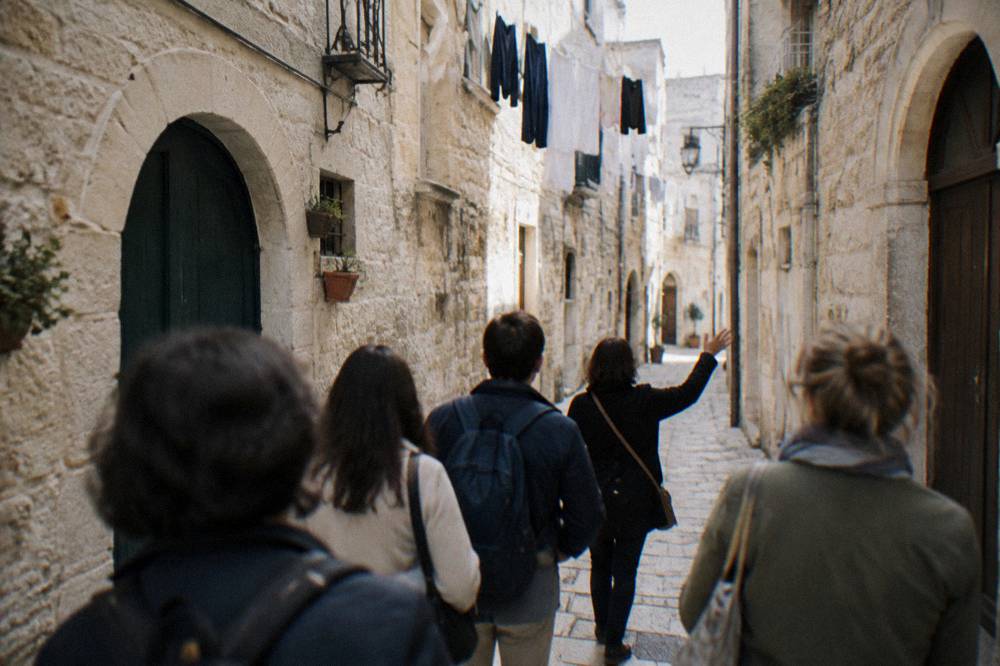
The city of about 316,000 residents divides cleanly in two. Bari Vecchia, the old town, sits on the headland between the old port and the Murat district, a grid of shopping streets around Via Sparano. Everything in the first half of this list is inside or beside Bari Vecchia, and each of those sights sits within a short walk of the others.
The Basilica Di San Nicola And The Crypt In Bari Vecchia
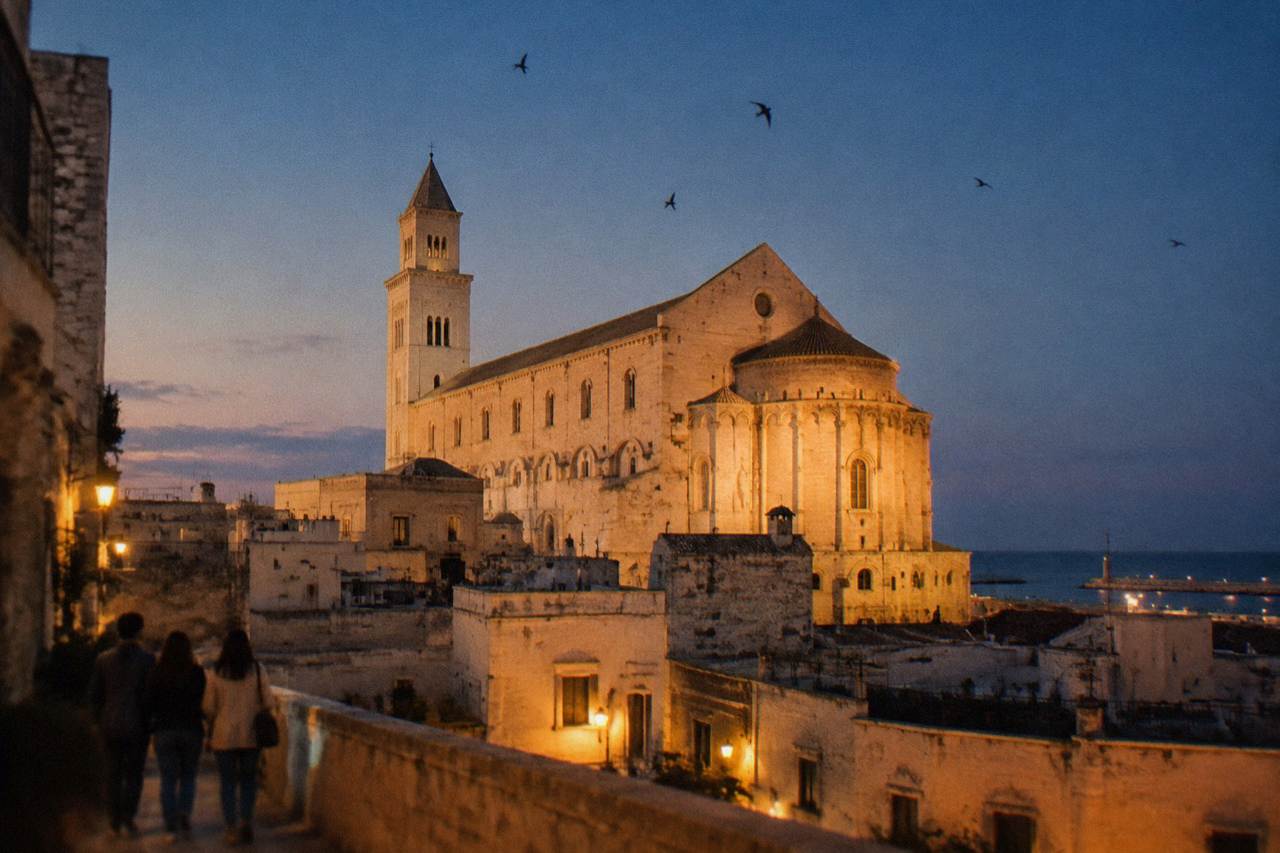
The Basilica di San Nicola is open Monday to Saturday 06:30 to 20:30 and Sunday 06:30 to 22:00, with no admission fee mentioned on its page, and it holds the relics of Saint Nicholas in the crypt below, brought to Bari by sailors in 1087 and placed there in 1089. The relics had rested at Myra about 750 years, from 337 to 1087.
The story is the reason the basilica exists and the reason Bari appears on pilgrimage routes at all. The basilica's own translation page gives the timeline: the relics left Myra in 1087, and two years later they were placed in the crypt, where they remain. The crypt is reached from inside the basilica, and the basilica's page lists no separate fee for it. Readers who want the full relic story can read whether Saint Nicholas is buried in Bari.
Around the basilica, Bari Vecchia opens out. Piazza Mercantile and Piazza del Ferrarese, the two squares on the old town's southern edge, hold cafes and the tourist information point at Piazza del Ferrarese 29. The Cattedrale di San Sabino stands a few lanes north, near the basilica. Strada Arco Basso is a lane inside the old town.
A guided walk is the efficient way to cover the old town lanes, since the quarter is compact but tangled. The pick above sets out from Bari. For readers deciding between Bari and the region's other baroque city, the comparison page on which is better, Bari or Lecce covers the trade-offs.
The Castello Normanno-Svevo And Bari's Museums
The Castello Normanno-Svevo costs 10 EUR full and 2 EUR reduced, per the Musei Puglia ticket page, and opens Tuesday to Sunday 09:00 to 19:00, with Sunday hours of 09:00 to 13:30 from October to March except the first Sunday of each month. The Puglia Musei Card at 20 EUR covers all regional Musei Puglia sites for 6 months.
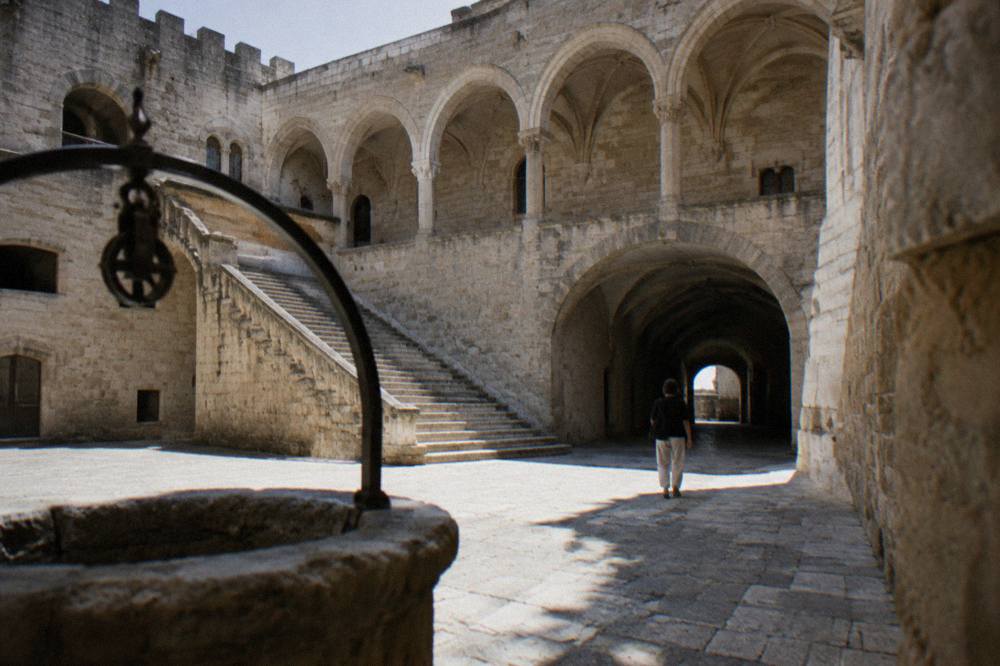
The Swabian castle sits at the western edge of Bari Vecchia, at the junction of piazza Federico II di Svevia and piazza Massari, and it anchors the old town's street plan. Since 1 July 2026 that junction is also a camera gate for the old town's limited traffic zone, so a rental car should never be driven past it into Bari Vecchia. Park outside the old town and walk in.
Two city museums sit on the seafront south of the old town, and both publish their figures. The Pinacoteca Metropolitana Corrado Giaquinto is open Tuesday to Saturday 09:00 to 19:00 with last entry 18:30, and Sunday 09:00 to 13:00 with last entry 12:30, closed Monday, at 5 EUR full and 2 EUR reduced, with an 8 EUR combined ticket. The Museo Archeologico di Santa Scolastica keeps the same weekday hours, at 5 EUR full and 2 EUR reduced for ages 18 to 25, with a combined ticket with the Pinacoteca and free entry on the first Sunday of the month.
| Sight in Bari | Full ticket | Reduced ticket | Hours |
|---|---|---|---|
| Basilica di San Nicola | No fee listed on its page | Not applicable | Mon to Sat 06:30 to 20:30, Sun 06:30 to 22:00 |
| Castello Normanno-Svevo | 10 EUR | 2 EUR | Tue to Sun 09:00 to 19:00 |
| Pinacoteca Metropolitana Corrado Giaquinto | 5 EUR | 2 EUR | Tue to Sat 09:00 to 19:00, Sun 09:00 to 13:00 |
| Museo Archeologico di Santa Scolastica | 5 EUR | 2 EUR | Tue to Sat 09:00 to 19:00 |
| Teatro Petruzzelli guided tour | 7 EUR | 2 EUR | Dated slots published monthly |
| Puglia Musei Card | 20 EUR | Not applicable | All Musei Puglia sites, 6 months |
The Teatro Petruzzelli, on the edge of the Murat district near the old town, runs guided tours of the foyer and stalls at 7 EUR full and 2 EUR reduced, with dated slots published each month on the theatre's own visits page. The theatre burned on the night of 26 to 27 October 1991 and reopened on 4 October 2009, a span the Italian press still cites when it writes about the building. Nearby, the city publishes no current hours for the Teatro Margherita, so check locally.
Street Food And Orecchiette In Bari Vecchia
The foods not to miss in Bari are orecchiette, the pasta shape of Puglia, focaccia barese, panzerotti, sgagliozze and raw seafood, and the old town is where the street food scene concentrates, around Strada Arco Basso, Piazza Mercantile and the fish market area at Molo San Nicola. No official source lists market days or stalls, so walk the lanes and see what is open.
Each of those foods needs only a sentence. Orecchiette is the ear-shaped pasta of Puglia, typically served with turnip tops. Focaccia barese is the city's tomato-topped flatbread. Panzerotti are small fried turnovers, usually filled with tomato and mozzarella. Sgagliozze are fried squares of polenta, an old town street snack. Raw seafood, sea urchins among them, is served at the raw fish counters of the old port area. This site keeps a fuller page on what food Bari is famous for.
The pasta makers of Strada Arco Basso, when they are working, shape orecchiette by hand at tables and doorways. No official page confirms their days or hours, so the honest framing is that the street is called the Strada delle Orecchiette and you may find makers at work, or you may not. A cooking class is the guaranteed way to see the technique: the pasta and tiramisu classes in the city teach orecchiette shaping in a home kitchen, and the walking tour with an orecchiette class combines the old town walk with the lesson. The full index of guides sits on Bari Italy Travel Guide.
The food walk above runs from Bari and covers the old town's counters and bakeries with a local guide. Readers planning the whole eating side of a visit can also check the site's guide to Bari's street food and the page on Bari restaurants for sit-down options beyond the street counters.
The Lungomare Nazario Sauro And Bari's City Beaches
The Lungomare Nazario Sauro is the seafront promenade that runs from the old port south past Madonnella, and the city beaches along it are Pane e Pomodoro at about 2.1 km from Piazza Mercantile, Torre Quetta at about 3.9 km and San Girolamo at about 4.3 km to the north-west. Facilities and charges vary by season and should be confirmed locally.
The promenade is the city's free pleasure: a flat walk beside the Adriatic, with the Teatro Margherita at the start and the city beaches further south. ARPA Puglia, the regional environment agency, reports that Puglia ranked first in Italy for bathing water quality for the sixth consecutive year, with 99.9 percent of waters rated excellent, and 78 bathing waters monitored in the province of Bari. Bari itself holds no Blue Flag in 2026; the province's Blue Flags are at Polignano a Mare and Monopoli, per the Regione Puglia announcement.
The sea warms to about 27 C in July and August, about 22 C in October and about 14 C in February, as modelled 2023 to 2025 means. On land, typical values from modelled ERA5 data, 1991 to 2020, put the August mean daily maximum at 29.1 C and July at 28.6 C, with about 4 rain days in each of July and August, so the seafront is at its fullest in high summer. Readers weighing months can check the best month to visit Bari.
Day Trips Not To Miss From Bari
The day trips not to miss from Bari are Polignano a Mare at 37.4 km by road, Monopoli at 47.3 km, Alberobello and its trulli at 56.7 km, the Grotte di Castellana at 43.1 km, Castel del Monte at 62.0 km and Matera at 70.8 km across the regional border in Basilicata. Castel del Monte, a UNESCO World Heritage site since 1996, costs 10 EUR full and 2 EUR reduced.
Distances above are free-flow road distances from Piazza Mercantile. By rail, Trenitalia regional trains on the Bari-Lecce line serve Polignano a Mare at 33 km, Monopoli at 41 km, Ostuni at 75 km and Lecce at 150 km; a Polignano trip typically takes 25 to 35 minutes, though the operator's timetable sets the exact train. The Trulli Link service links Trenitalia and FSE trains to Locorotondo, Alberobello and Martina Franca in the Valle d'Itria, with the FSE leg reported at 5.90 EUR on top of the rail fare, so confirm before you go. FAL runs the railway line from Bari through Altamura and Gravina in Puglia to Matera; check the operator's timetable for the current schedule.
| Day trip from Bari | Road distance from Piazza Mercantile | Drive time, free-flow | Entry cost where published |
|---|---|---|---|
| Polignano a Mare | 37.4 km | about 36 min | No entry fee found |
| Grotte di Castellana | 43.1 km | about 47 min | Full route 25 EUR, partial 22 EUR |
| Monopoli | 47.3 km | about 43 min | No entry fee found |
| Alberobello | 56.7 km | about 61 min | Not on official pages |
| Castel del Monte | 62.0 km | about 59 min | 10 EUR full, 2 EUR reduced |
| Matera, Sassi | 70.8 km | about 69 min | Not on official pages |
| Lecce | 151.1 km | about 115 min | Not on official pages |
Two of those rows need a note. Matera is in Basilicata, not Puglia, so the trip crosses a regional border; the Sassi are the old stone districts of the town and a UNESCO World Heritage site. Lecce at 151 km is a long day by road, better suited to an overnight or a direct train from Bari Centrale. The site's longer rundown of good day trips from Bari covers each town in detail.
The Grotte di Castellana publish their own prices: the full route, 3 km and about 100 minutes, costs 25 EUR for ages 15 and over, and the partial route, 1 km and about 50 minutes, 22 EUR. Castel del Monte, the octagonal castle inland from Andria, opens daily 10:00 to 18:45 from 1 April to 30 September and 09:00 to 17:45 from 1 October to 31 March, with last entry 45 minutes before closing. Both belong on any second day in the area.
One of the picks above departs from Matera itself, not from Bari, so it suits a day when you have already travelled there and want a guided walk through the Sassi with entry to a rock-cut church. The other two start in Bari. Readers working out the length of a stay can read how many days in Bari is enough before booking anything.
Common Questions About What Not To Miss In Bari
What not to miss in Bari, Italy?
The Basilica di San Nicola and its crypt, the Castello Normanno-Svevo at 10 EUR full entry, the lanes of Bari Vecchia around Piazza Mercantile and the old port, the street food of the old town, and the Lungomare Nazario Sauro seafront, with Polignano a Mare, Alberobello and Matera as day trips.
How many days do you need in Bari?
Two days cover the old town, the castle, the museums and the seafront; a third and fourth day open the day trips to Polignano a Mare, Alberobello, Castel del Monte and Matera, each of which sits within about 71 km of the city centre by road.
Is Bari Vecchia worth visiting?
Yes: the old town holds the basilica, the cathedral, the Swabian castle, Piazza Mercantile, Piazza del Ferrarese and the pasta lane Strada Arco Basso, all within a compact headland you can cross on foot. It is also a limited traffic zone, so arrive on foot or by bus, never by rental car.
What food should you try in Bari?
Orecchiette with turnip tops, focaccia barese, panzerotti, sgagliozze and raw seafood from the old port counters. Each is a plain local specialty of the city and the region, and the old town is where the street versions concentrate.
Can you visit Polignano a Mare and Alberobello on the same day?
Yes, they are 37.4 km and 56.7 km from Bari by road. Polignano sits on the Trenitalia Bari-Lecce rail line, while Alberobello is reached by the Trulli Link service or by bus, so both can be combined by tour bus or with an early start.
When is the Festa di San Nicola in Bari?
The patronal feast runs early May, 7 to 9 May, by tradition. The 2026 edition held its historical procession on 7 May at 20:00 from piazza Federico II di Svevia, with the sea procession and the manna reported on 8 and 9 May.
Bari rewards a slow first day in the old town and an unhurried second day on the seafront, then pays out on the day trips. Plan the basilica early, the castle before the afternoon, the food walk when you are hungry, and leave Matera a full day of its own across the border in Basilicata.