Is Saint Nicholas Buried In Bari?
Yes, Saint Nicholas's relics rest in Bari, in the crypt of the Basilica di San Nicola, brought by sailors from Myra in 1087. What the sources say, how to visit and when the city celebrates him.
Bari, the capital of the Puglia region on the Adriatic coast of southern Italy, holds one of the most consequential burial sites in medieval Christianity. The relics of Saint Nicholas, the bishop of Myra whose story became the figure now attached to Christmas gift-giving, were carried to this port city by sailors in 1087 and placed beneath the altar of a church built to receive them. The question of whether Saint Nicholas is buried in Bari therefore has a direct answer, and it opens a story of relics, rivalry and a feast that still fills the old town every May. This page sets out what the primary sources say, where exactly the relics rest, and how a visitor to Bari Vecchia can stand in front of them today.
Is Saint Nicholas Buried In Bari?
Yes, in the sense that matters: the relics of Saint Nicholas rest in the crypt of the Basilica di San Nicola in Bari, in the heart of Bari Vecchia. According to the basilica's own history page, they rested at Myra for about 750 years, from 337 to 1087, were brought to Bari by sailors in 1087, and were placed in the crypt in 1089, where they remain the centre of the city's religious life.
The precision is worth a sentence. Saint Nicholas died as bishop of Myra, in what is now Turkey, and his remains lay there for roughly seven and a half centuries. What came to Bari in 1087 were those relics, carried off by sailors from the city, an event the sources call the translazione. The crypt beneath the basilica was prepared to house them, and in 1089 they were installed there. So the tomb of Saint Nicholas, as the world knows it, is in Bari, and pilgrims have travelled to it for close to a thousand years.
The basilica that grew over the crypt became one of the landmarks of southern Italy and the anchor of the whole old town. It sits a short walk from the Cattedrale di San Sabino, Piazza Mercantile and Piazza del Ferrarese, and it gives Bari a claim no other city in Italy can make: the body of the saint who became Santa Claus lies under its floor. The full history of the city and the saint is covered in the guide to Bari's history and Saint Nicholas.
Where Exactly The Relics Rest Inside The Basilica
The relics lie in the crypt under the main altar of the Basilica di San Nicola, in a space the basilica's own site treats as an integral part of the church rather than a separate ticketed attraction. The basilica is open Monday to Saturday from 06:30 to 20:30 and on Sunday from 06:30 to 22:00, and its page mentions no admission fee.
Visitors descend from the nave into the crypt, where the tomb sits below the altar. The basilica publishes its opening hours on its own site, and those hours, unusually wide for an Italian church, reflect the building's role as a working pilgrimage destination rather than a museum. No separate crypt fee appears on the page, and none should be assumed: check locally on the day of a visit, since liturgical events can close parts of the church at short notice.
| What | Detail |
|---|---|
| Relics | Saint Nicholas, brought from Myra by sailors in 1087, placed in the crypt in 1089 |
| Location | Crypt below the main altar, Basilica di San Nicola, Bari Vecchia |
| Basilica hours | Monday to Saturday 06:30 to 20:30, Sunday 06:30 to 22:00 |
| Admission | No fee mentioned on the basilica's page |
| Museo Nicolaiano | Reported at about 10:30 to 18:00, with one bulletin listing a Wednesday closure, confirm before you go |
Nearby, the Museo Nicolaiano, reached from Largo Urbano II, holds material connected with the basilica and the cult of the saint. Its hours are reported at about 10:30 to 18:00, and one basilica bulletin lists a Wednesday closure: treat both as reported and confirm before you go. The basilica itself needs no such caution; its hours are published and generous, and the early morning or late evening hours are the quietest for standing at the tomb.
Seeing the crypt with a guide adds the story to the stones. The Bari guided walking tour covers the basilica and the lanes of Bari Vecchia, and an old town tour with street food pairs the same quarter with the city's focaccia and panzerotti. Both leave from the city centre.
How The Relics Reached Bari In 1087
Sailors from Bari removed the relics from Myra in 1087, after the saint's remains had rested there for about 750 years, from 337 to 1087, and the transfer gave Bari both its patron and its principal monument. The crypt received them in 1089, and the basilica rose over the tomb as the pilgrimage destination it remains today.
The episode belongs to a world in which relics were both devotional objects and assets of the cities that held them. Myra, on the southern coast of Asia Minor, lay increasingly exposed as imperial power receded, and seafaring cities of the Adriatic and the Aegean competed for the prestige of major saints. Bari's sailors reached the shrine, took the relics, and brought them home. The basilica's history page narrates the translation plainly: about 750 years at Myra, the crossing in 1087, the placement in the crypt in 1089.
| Year | Event |
|---|---|
| 337 | Death of Saint Nicholas, bishop of Myra; his relics rest there |
| 337 to 1087 | The relics remain at Myra for about 750 years |
| 1087 | Bari sailors bring the relics to Bari |
| 1089 | The relics are placed in the crypt of the Basilica di San Nicola |
One point of confusion travels with the story. Other cities have claimed fragments and relics of the saint over the centuries, and casual reading can leave the impression that the question is unsettled. For Bari the sources are direct: the relics were translated in 1087 and installed in 1089, and the crypt has held them since. The city built its identity around that fact, and the feast that commemorates it each May re-enacts the arrival by sea.
Can You Visit The Crypt Of San Nicola Today?
Yes, and it is one of the simplest major sights in southern Italy to visit: the Basilica di San Nicola opens Monday to Saturday from 06:30 to 20:30 and Sunday from 06:30 to 22:00, its page mentions no admission fee, and the crypt is part of the church. A walk through Bari Vecchia, the old headland quarter, brings you to the door in minutes from Piazza Mercantile.
The practical part of a visit is the old town itself. Bari Vecchia is a compact peninsula of lanes around the basilica, the Cattedrale di San Sabino, Piazza Mercantile, Piazza del Ferrarese and the Castello Normanno-Svevo, the Swabian castle, whose entry costs 10 euro full and 2 euro reduced per the Musei Puglia ticket page. Two drivers' warnings apply: Bari Vecchia is a limited traffic zone with a camera gate at the Castello, so do not drive into it, and the airport transfer is simple without a car, since the Ferrotramviaria train covers the 12 km from the Karol Wojtyla airport to Bari Centrale in 17 minutes for 5.30 euro.
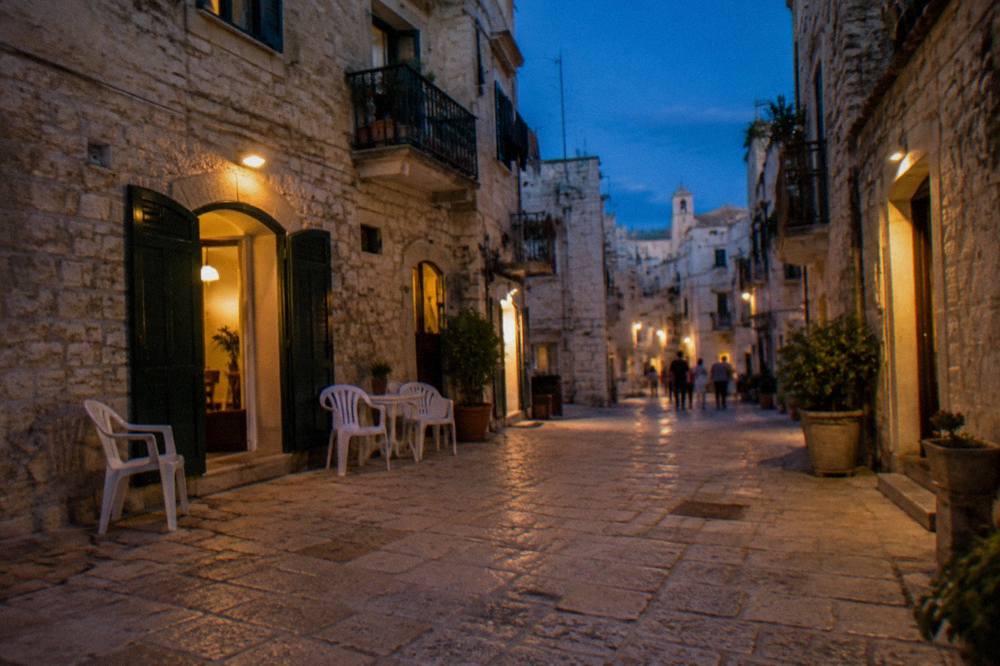
Walking tours of the old town pair the crypt with the surrounding quarter, and the wider city rewards a second day: the Murat district's grid of shopping streets, the Lungomare Nazario Sauro along the sea, and the day trips to Polignano a Mare, Monopoli, Alberobello and Matera, the last of them across the regional border in Basilicata. If the saint's story has drawn you to the city, the question of how many days in Bari is enough usually answers itself at two or three, with a day trip added.
The Festa Di San Nicola In Early May
The city celebrates its patron every year in early May, 7 to 9 May, and the 2026 programme put the historical procession on Thursday 7 May 2026 at 20:00 from piazza Federico II di Svevia, with the sea procession on 8 May and the manna on 9 May reported as part of the traditional programme. The 2027 programme had not been announced.
The feast re-enacts the arrival of the relics. A boat carrying the saint's image is met at the old port and carried in procession to the basilica, the streets of Bari Vecchia fill with lights and stalls, and the Sagra around the old town ran 7 to 10 May in 2026. Traffic restrictions and altered bus routes are posted by the comune for the feast days, so a visitor planning those dates should expect crowds and check the local notices.
| Feast event | Detail |
|---|---|
| Dates | Early May, 7 to 9 May by tradition |
| Corteo storico | 7 May 2026, 20:00, from piazza Federico II di Svevia |
| Sea procession | 8 May, reported as part of the traditional programme |
| Manna | 9 May, reported |
| Sagra | 7 to 10 May 2026 |
Outside the feast days the basilica is quieter but no less working: Masses, Orthodox pilgrimages and ordinary visits share the space, and the crypt holds services of its own. The tomb has drawn both Catholic and Orthodox devotion for centuries, one reason the basilica keeps hours that stretch from dawn to 20:30 and, on Sundays, to 22:00.
Common Questions About Saint Nicholas In Bari
Is Saint Nicholas buried in Bari?
Yes: his relics have rested in the crypt of the Basilica di San Nicola since 1089, brought from Myra by Bari sailors in 1087. The crypt is open as part of the basilica, Monday to Saturday 06:30 to 20:30 and Sunday 06:30 to 22:00.
When did the relics arrive in Bari?
The relics left Myra in 1087, after resting there for about 750 years, from 337 to 1087, and were placed in the crypt in 1089, according to the basilica's own history page.
Is there an entry fee for the Basilica di San Nicola?
The basilica's page mentions no admission fee. Check locally on the day of a visit, since services can restrict access to parts of the church.
When is the Festa di San Nicola?
Early May, 7 to 9 May by tradition. The 2026 edition opened with the historical procession on 7 May at 20:00 from piazza Federico II di Svevia; the 2027 programme had not been announced.
Where is the Basilica di San Nicola?
In Bari Vecchia, the old town on the headland, a short walk from Piazza Mercantile, Piazza del Ferrarese and the Swabian castle. Do not drive into Bari Vecchia: it is a limited traffic zone with camera enforcement.
The relics of Saint Nicholas gave Bari its patron, its basilica and its May feast, and they remain central to the city's identity. Whether you come for the tomb itself or find it between a plate of orecchiette and a walk along the Lungomare Nazario Sauro, the crypt under the basilica is open most hours of the day, and the answer to the question that brought you here is written into the floor of the church. For everything else the city offers, start with the Bari Italy Travel Guide and its overview of the top sights across Bari.