Is Amalfi Coast Or Puglia Better?
Amalfi Coast or Puglia? An honest comparison from Bari, the capital of Puglia, covering landscapes, costs, transport and day trips, with figures for the Puglia side.
Bari is the capital of the Puglia region in southern Italy, a coastal city on the Adriatic Sea, and it is not on the Amalfi Coast: the Amalfi Coast lies on the opposite side of the country, on the Tyrrhenian Sea south of Naples, while Puglia is the heel of the Italian boot. The two are often placed in the same sentence because both promise sea, old stone towns and long lunches, but they are different products. This comparison is written from the Puglia side, from Bari, using the figures the sources give for Puglia and describing the Amalfi Coast in words, with no invented numbers for either coast. If you want the short version of is Bari Italy worth visiting, read on.
Is Amalfi Coast Or Puglia Better?
Neither is objectively better, and the honest answer depends on what you want: the Amalfi Coast concentrates dramatic cliffs and a single famous 50 km ribbon of road into a short, intense stay, while Puglia spreads a longer, cheaper, flatter and less crowded set of experiences across an entire region, with Bari as its capital and transport hub. Puglia rewards a week, the Amalfi Coast rewards three or four days.
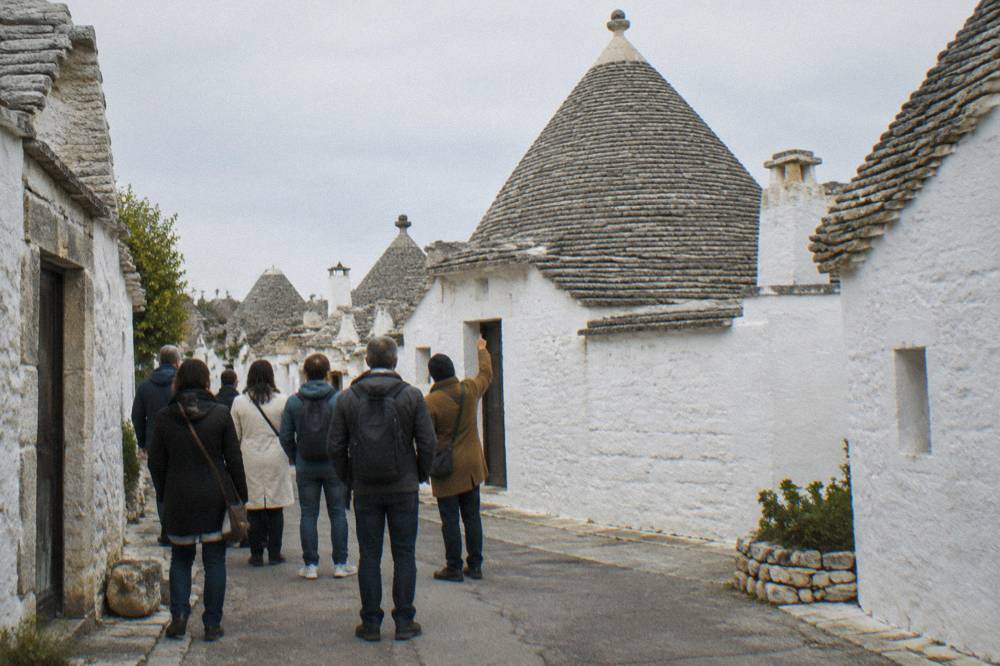
The Amalfi Coast is a single strip between Sorrento and Salerno, built around Positano, Amalfi and Ravello, and it is famous for one specific look: vertical towns, lemon terraces and a road cut into the cliff. Puglia does not have that single look. It has the white hill towns of the Valle d'Itria, the trulli of Alberobello, a UNESCO World Heritage site, the Sassi of Matera just over the regional border in Basilicata, the sprawl of Lecce at the far end of the region, and two working port cities, Bari and Brindisi, that most Amalfi itineraries have no equivalent of. Matera is in Basilicata, not Puglia: the day trip from Bari crosses a regional border.
Crowding is the practical difference. The Amalfi Coast is a single road with a worldwide reputation, so the pressure concentrates. Puglia's attractions are spread over roughly 150 km of rail line from Bari to Lecce and a network of towns beyond it, so the same number of visitors thins out across a much larger area.
Cost behaves the same way. The only accommodation cost that can be stated with a figure is Bari's tourist tax, 1.50 to 4.00 euro per person per night depending on category, for a maximum of 4 consecutive nights per calendar year, collected by the accommodation. Each comune in Puglia sets its own tax, so a stay in Polignano a Mare or Alberobello follows that town's rules, not Bari's: your host will state what applies.
What Does Each Coast Look And Feel Like?
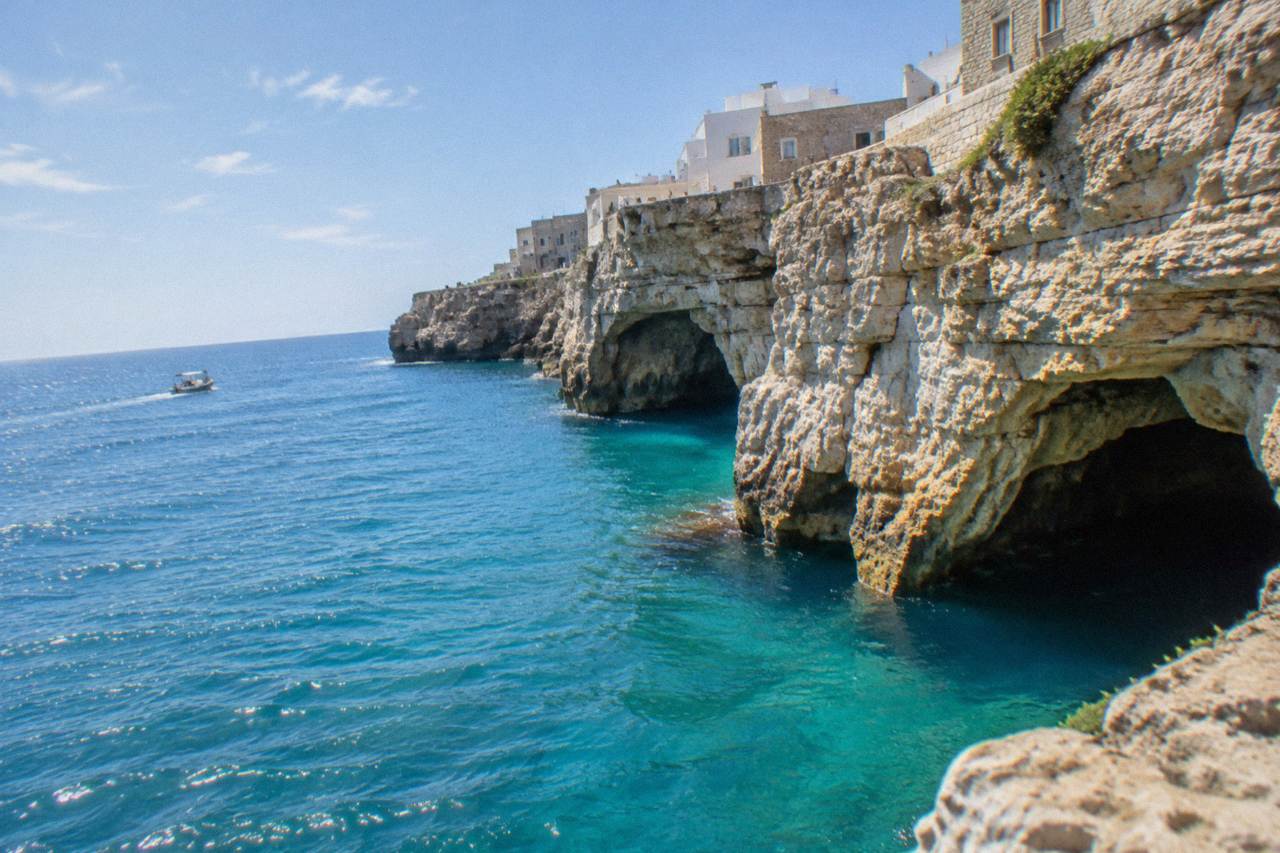
The Amalfi Coast is vertical: cliffs, hairpin roads and towns stacked above the water, while Puglia is horizontal and varied, with long flat coastline around Bari, cliff edges at Polignano a Mare, dry rolling valley country in the Valle d'Itria, and high plateau towns like Altamura and Gravina in Puglia inland. Puglia's scenery arrives in separate chapters rather than one continuous view, and the chapters are far apart: Polignano a Mare is 37.4 km and about 36 minutes by road from Bari's Piazza Mercantile, Alberobello 56.7 km and about 61 minutes, Matera about 71 km and 69 minutes.
The contrast matters for how a day feels. On the Amalfi Coast, the day is the road and the towns on it. In Puglia, a day is a journey: Bari Vecchia in the morning, a train down the coast in the afternoon, and back for dinner on the Lungomare Nazario Sauro. The Basilica di San Nicola is open Monday to Saturday 06:30 to 20:30 and Sunday 06:30 to 22:00, with no admission fee mentioned on its page, which is the kind of access that shapes a Puglia itinerary: the region's headline sight costs nothing to enter.
The water itself differs. Around Bari the coast is low and urban, with the city beaches Pane e Pomodoro about 2.1 km from Piazza Mercantile and Torre Quetta about 3.9 km. The dramatic swimming and cave scenery sits at Polignano a Mare, 33 km down the Bari-Lecce rail line. Bari itself has no Blue Flag beach in 2026: the Blue Flags in the Province of Bari are at Polignano a Mare and Monopoli. For bathing quality, ARPA Puglia reports the region first in Italy for the sixth consecutive year, with 99.9 percent of bathing waters classed excellent and 78 bathing waters monitored in the Province of Bari.
All three picks above run in the two places this article names: the two Polignano products depart from Polignano a Mare, not from the Bari waterfront, and the old town food tour runs in Bari itself. Together they sketch the Puglia argument: cliff caves, cliff food, city streets.
Which Is Easier To Reach And Get Around?
Bari has its own airport, Karol Wojtyla (BRI), 12.0 km and about 21 minutes by road from Piazza Mercantile, with a Ferrotramviaria train to Bari Centrale in 17 minutes for 5.30 euro and a fixed airport taxi fare of 25 euro. From Bari Centrale, Trenitalia regional trains run the Bari-Lecce line through Polignano a Mare at 33 km, Monopoli at 41 km, Ostuni at 75 km and Lecce at 150 km.
The train station at Bari Centrale question and the airport question have unusually clean answers by southern Italian standards. The airport station is inside the terminal. A contactless card can be tapped at the gate under the Paga e Via scheme at the same 5.30 euro fare. The Tempesta shuttle coach costs 5 euro, bought on board or in the Cotrap app. Within the city, AMTAB buses charge 1.00 euro for a single ride, 1.20 euro for a 90-minute ticket and 2.50 euro for a day ticket.
One warning that applies to Puglia only if you drive: Bari Vecchia is a limited traffic zone, with a camera gate at the Castello in operation since 1 July 2026. Do not drive into the old town. Park outside and walk in; perimeter parking near Bari Vecchia is paid on working days 08:30 to 20:30. The Amalfi Coast has its own driving constraints in summer, and those are best checked locally before you commit to a car there.
Getting around the two regions is where the comparison tilts hardest. The Amalfi Coast is one road plus ferries plus the Sorrento rail terminus; movement is a known bottleneck. Puglia is a lattice: the coastal rail line south, the FSE network into the Valle d'Itria through the Trulli Link service to Locorotondo, Alberobello and Martina Franca, the FAL line toward Altamura, Gravina in Puglia and Matera, and ordinary roads everywhere else. A week based in Bari can be run entirely on trains and buses, as the one week Puglia itinerary from Bari shows. Check each operator's timetable for the day you travel, and confirm that service changes during works are posted before a tight connection.
How Do The Costs And Sights Compare?
Puglia's headline sights carry small, printed prices: the Castello Normanno-Svevo in Bari costs 10 euro full and 2 euro reduced, Castel del Monte 10 euro and 2 euro, the Grotte di Castellana 25 euro for the full 3 km route, and the Basilica di San Nicola has no admission fee mentioned, while no comparable Amalfi Coast price list exists in this article's source material, so no figure is stated for that side. A Puglia Musei Card at 20 euro covers all the regional state museum sites, including the castle, for 6 months.
That bold answer gives the honest shape of the cost question. What can be compared with figures, compared below, is the Puglia side only; for Amalfi Coast entry prices, restaurants and rooms, check the venue or operator directly. The pattern, though, is visible in the table: Puglia's paid sights are inexpensive relative to their fame, and its single greatest sight, the old town of Bari itself, costs nothing to walk.
| Sight | Where | Full ticket | Reduced |
|---|---|---|---|
| Castello Normanno-Svevo | Bari, old town | 10 EUR | 2 EUR |
| Basilica di San Nicola | Bari, old town | no fee mentioned on its page | no fee mentioned |
| Castel del Monte (UNESCO 1996) | 62.0 km from Piazza Mercantile | 10 EUR | 2 EUR |
| Grotte di Castellana, full 3 km route | 43.1 km, about 47 minutes by road | 25 EUR (ages 15 and over) | 22 EUR (ages 6 to 14) |
| Swabian castle of Trani | 47.2 km, about 45 minutes by road | 8 EUR | 2 EUR |
| Pinacoteca Metropolitana Corrado Giaquinto | Bari, Lungomare Nazario Sauro | 5 EUR | 2 EUR |
| Teatro Petruzzelli guided tour | Bari, near the old town | 7 EUR | 2 EUR |
The second comparison that can be made with real numbers is distance and time. These are free-flow road figures from Piazza Mercantile in Bari, computed from the route network, and they show how far Puglia's sights actually sit from each other. The Amalfi Coast equivalent would be a single corridor, so the table doubles as the argument: in Puglia you choose a direction each morning.
| Destination | Distance by road from Piazza Mercantile | Drive time, free flow | Rail distance where served |
|---|---|---|---|
| Polignano a Mare | 37.4 km | about 36 minutes | 33 km on the Bari-Lecce line |
| Monopoli | 47.3 km | about 43 minutes | 41 km |
| Alberobello | 56.7 km | about 61 minutes | served by the Trulli Link |
| Castel del Monte | 62.0 km | about 59 minutes | not on the coastal line |
| Ostuni | 85.3 km | about 73 minutes | 75 km |
| Matera (Sassi, in Basilicata) | 70.8 km | about 69 minutes | FAL line, change of region |
| Lecce | 151.1 km | about 115 minutes | 150 km |
The distances explain the itinerary advice on how many days in Bari is enough: Lecce is far, about two hours each way by road, and works as a long day or an overnight rather than a quick hop. Alberobello, Locorotondo and the Valle d'Itria cluster better. If the Amalfi Coast's compactness appeals, the Puglian answer is to base in one place for three or four nights and accept the drives, or to follow the Monopoli or Polignano debate and base on the coast itself.
How Does The Weather Compare Across The Year?
Bari's climate, from typical values of modelled ERA5 data, 1991 to 2020, gives July a mean daily maximum of 28.6 C and August 29.1 C, with January and February highs about 12 C, about 587 mm of rain across the year and about 4 rain days in July and August, and no comparable station figures for the Amalfi Coast are available in the source material. November averages 73 mm of rain and August 20 mm, so the shoulder seasons, May and late September, sit in the drier, milder middle of the table.
The seasonal logic differs between the coasts. The Amalfi Coast's season is sharply peaked, and the sea is the point of the trip. Puglia has a longer usable season because so much of it is not a beach: the trulli of Alberobello, the Sassi of Matera, the museums and churches of Bari and the food culture run in every month. The sea around Bari averages about 27 C in July and August, about 22 C in October and about 14 C in February, as modelled 2023 to 2025 means, so the swimming window is honest but not endless.
For timing, the best month to visit Bari question is answered by the same table: May averages a 21.6 C high with 35 mm of rain, and late September sits at 25.1 C with 53 mm.
Which Should You Choose For Your Trip?
Choose the Amalfi Coast for a short, dramatic, single-image trip: three or four days, one road, vertical views, and a budget built for it. Choose Puglia, with Bari as the base, for a longer, cheaper-per-sight, more varied trip: a week or more, trains and buses, cave boats, trulli, the Sassi of Matera, two Blue Flag towns down the coast and a food culture that starts at the city gate. If the trip is five days or fewer and the priority is the view, Amalfi. If it is a week or more and the priority is variety, Puglia.
The food argument belongs to Puglia in this comparison, and it can be made without a single invented number: orecchiette is the pasta shape of Puglia, and Bari's street food runs to panzerotti, focaccia barese and raw seafood, each describable in one plain sentence and each eaten standing up. The food Bari is famous for is not an accessory to the sights, it is the reason to come, and the valley towns extend it with olive oil and wine. This site's own featured pick makes the point: a guided street food walk in Polignano a Mare, departing from Polignano, which pairs the cliff town with the food culture in one outing, Check availability on the operator's live listing.
The picks below collect the same argument in one band: food in Polignano, caves off the Polignano coast with drinks and swim stops, and a street food walk through Bari Vecchia.
A final structural point in Puglia's favour for some travellers: the region is a working place, and Bari is a working city of about 316,000 residents, not a stage set. The old port at Molo San Nicola still lands fish, the Murat district still shops, and the Fiera del Levante still goes about its business. The Amalfi Coast gives an intense, beautiful, curated experience; Puglia gives a region you can get lost in, with the Bari Italy Travel Guide covering every corner of it from the airport gate to the Sassi.
Common Questions About Amalfi Coast Or Puglia
Is Amalfi Coast or Puglia better?
Neither is objectively better. The Amalfi Coast suits a short, dramatic trip on one famous road; Puglia suits a longer, more varied trip based around Bari, with trains to Polignano a Mare, Monopoli, Alberobello, Matera and Lecce.
Is Bari on the Amalfi Coast?
No. Bari is the capital of Puglia, on the Adriatic Sea in southern Italy. The Amalfi Coast is on the Tyrrhenian Sea, south of Naples, on the other side of the country. See is Bari on the Amalfi Coast for the full answer.
Is Puglia cheaper than the Amalfi Coast?
No hotel or restaurant price can be quoted for either coast from this article's sources, so check rates directly.
Can you visit the Amalfi Coast and Puglia on one trip?
A realistic plan is to treat them as separate trips, or to fly into one region and out of the other, checking rail and flight connections before booking.
How many days do you need for Puglia?
A week based in Bari covers the city, Polignano a Mare, Monopoli, Alberobello and either Matera or the Grotte di Castellana. Lecce, about 115 minutes by road from Bari, works as a long day or an overnight at the end.
Which has better beaches, Amalfi Coast or Puglia?
The Amalfi Coast has small, dramatic coves; Puglia has long, flatter strands. Bari itself has no Blue Flag beach in 2026: the Province of Bari's Blue Flags are at Polignano a Mare and Monopoli, and ARPA Puglia classes 99.9 percent of the region's bathing waters as excellent.