Is Ostuni, Italy Worth Visiting?
Is Ostuni worth the day trip from Bari? An editorial look at the white hill town of Puglia, travel times, what to see and when to go.
Ostuni is a white-washed hill town in the Province of Brindisi, on the southern edge of Puglia in southern Italy, and for travellers based in Bari it is one of the standard day trips alongside Polignano a Mare, Monopoli, Alberobello and Locorotondo. The question of whether it deserves a day of a short trip has a real answer, but it depends on what you want: old-town atmosphere and views over olive country, or a packed schedule of named sights. The town itself publishes no headline attractions with ticket queues, and that is precisely the argument for and against it. This page works through the practical facts, the travel times from Bari, and how Ostuni compares with its neighbours in the Valle d'Itria, so you can decide with numbers rather than slogans. For a fuller picture of the region's capital, the Bari Italy Travel Guide covers the city itself.
Is Ostuni, Italy Worth Visiting?
Yes, for a day trip built around wandering, views and food, and Ostuni earns that verdict on geography alone: the town is about 85 km from Bari, roughly 73 minutes by road, and sits in the Province of Brindisi as a compact white old town above olive plains. What it does not offer is a list of ticketed monuments, so travellers who want structured sightseeing may prefer Alberobello's trulli or the caves at Castellana.
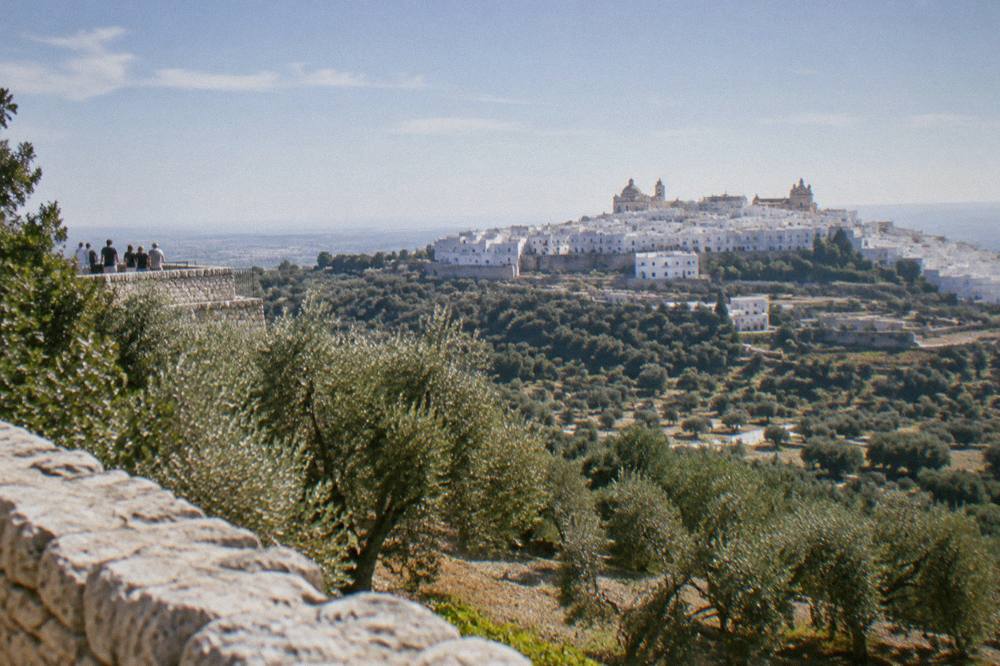
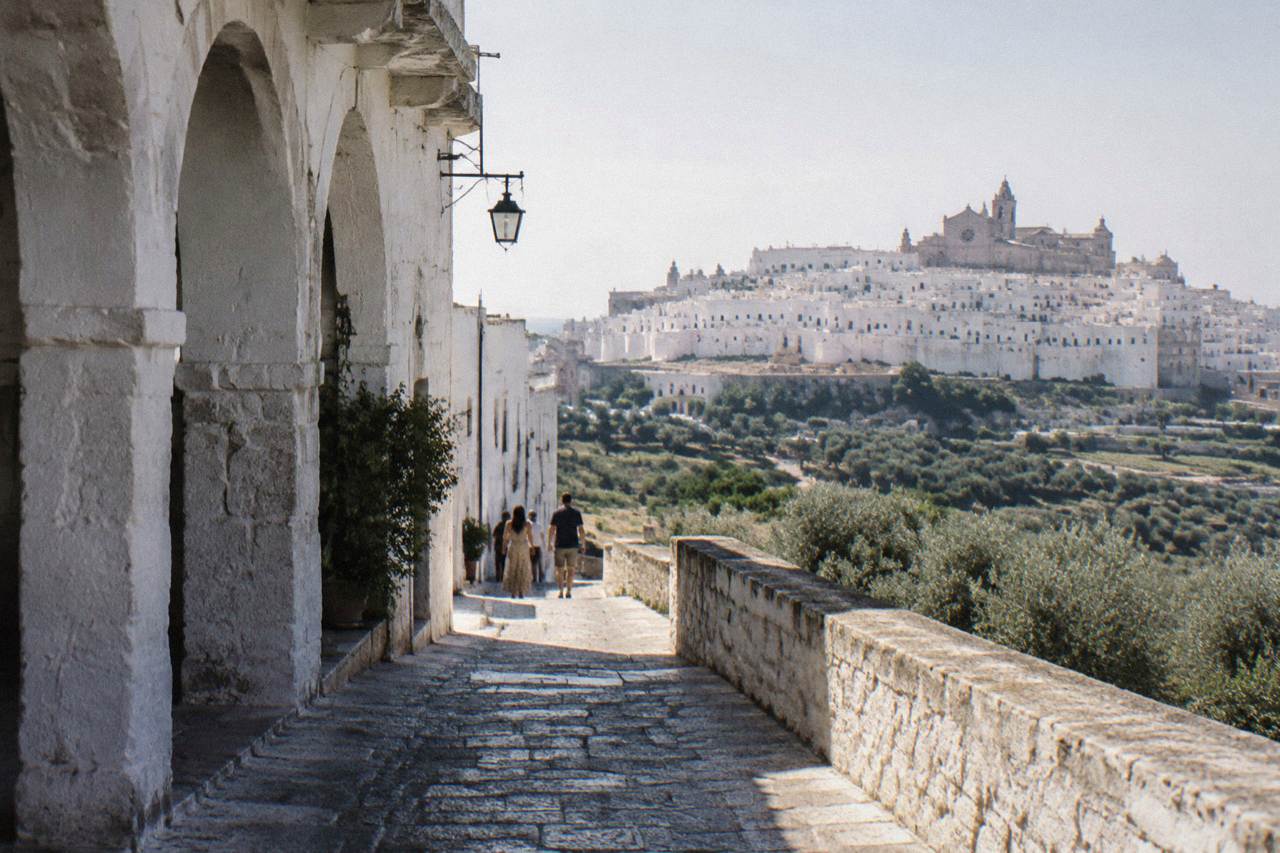
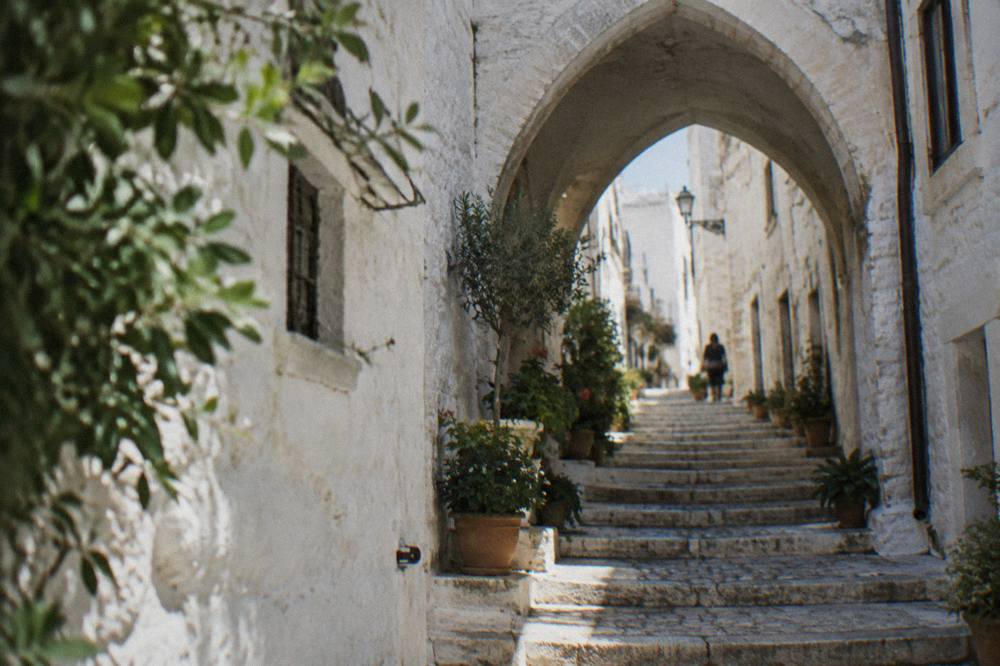
The honest case for Ostuni is atmosphere. The old town is a dense web of white-painted lanes, arches and stairways on a hill, and the pleasure of the place is the walk itself rather than any single landmark. That makes Ostuni a low-cost, low-planning destination: you arrive, you walk, you look at the olive plain that rolls towards the Adriatic, and you eat.
The honest case against it is the same fact read the other way. A traveller who wants a full day of named sights, museum hours and queued admissions will find the town quiet by early evening, and the return journey to Bari is over an hour by road. On a two-night stay in Bari, swapping Ostuni for a second visit to Polignano a Mare or the Basilica di San Nicola is a defensible choice. On a week based in Bari, the town slots in naturally alongside Monopoli, which sits on the same rail line towards Lecce.
The editorial judgement of this site is that Ostuni is worth visiting when it is paired with something else in the day, whether that is Monopoli on the coast, a farm visit in the olive country around the town, or a long lunch. Standing entirely alone as a full-day destination it is thinner, but as the hill-town half of a two-stop day it holds its own.
How Do You Get From Bari To Ostuni?
Ostuni is about 85 km from Bari by road, roughly 73 minutes in free-flow traffic from Piazza Mercantile, and the town is also a stop on the Trenitalia Bari-Lecce regional line at 75 km from Bari Centrale. There is no direct motorway-style link, so check the operator's own timetable and fare pages before booking anything.
The rail option is the one the sources describe directly: Trenitalia regional trains on the Bari-Lecce line serve Ostuni, 75 km down the line from Bari Centrale, and the same trains call at Polignano a Mare (33 km), Monopoli (41 km) and Lecce (150 km). No point-to-point fare for the Bari to Ostuni journey appears on an official page, and the exact journey time is not given either, so the operator's timetable is the place to confirm both. The station sits below the old town, and the walk or short taxi ride up the hill is part of the arrival.
The road option takes about 73 minutes in free-flow conditions, computed from routing data for the 85.3 km between Piazza Mercantile and Ostuni. With a rental car, the same road continues naturally to the Valle d'Itria towns: Locorotondo is about 69 km and 58 minutes from Bari, Alberobello about 57 km and 61 minutes, and Cisternino about 77 km and 67 minutes. One warning that applies to the whole region: if your route returns you into Bari itself, do not drive into Bari Vecchia. The old town has been a camera-enforced limited traffic zone since a new gate came into force at the castle on 1 July 2026, with weekday access windows reserved for authorised vehicles.
The Trulli Link intermodal service, which connects Trenitalia trains with FSE buses towards the Valle d'Itria, serves Locorotondo, Alberobello and Martina Franca, but it does not serve Ostuni, so that useful combination does not apply here. For pairing Ostuni with Monopoli by train, both are on the Bari-Lecce line, and the detailed routing is covered in the guide to Bari to Monopoli and Ostuni.
| Destination from Piazza Mercantile | Distance by road | Free-flow time |
|---|---|---|
| Ostuni | 85.3 km | about 73 minutes |
| Locorotondo | 68.8 km | about 58 minutes |
| Alberobello | 56.7 km | about 61 minutes |
| Cisternino | 77.0 km | about 67 minutes |
| Monopoli | 47.3 km | about 43 minutes |
| Lecce | 151.1 km | about 115 minutes |
Those figures are computed free-flow times from one fixed point in Bari, so real traffic, parking and the walk from a car park add time, above all in summer.
What Is There To See And Do Around Ostuni?
The core activity in Ostuni is the old town itself: walking the white lanes of the hill, the views over the olive plain, and eating, with no published entry fee for the historic centre. Around the town, the options are an olive-grove farm tour with oil tasting and an orecchiette-making class on a farm with wine, both bookable experiences that depart from the Ostuni area rather than from Bari.
Inside the town, the sources support description but not detail: no official page in the site's research lists opening hours for Ostuni's cathedral or civic buildings, and no fee for the historic centre is published anywhere. The town is described in general terms, a white hill town of the Province of Brindisi, and that is what a visitor gets. What the area around Ostuni does have, uniquely among the day trips, is working farmland: the olive country that surrounds the town supports agriturismo-style visits, and two of those are bookable products on this site.
The featured pick among these is the orecchiette class on an Ostuni farm, which departs from the Ostuni area, not from Bari, so it belongs on a day when you are already heading south. Orecchiette is the pasta shape of Puglia, and a class that teaches it in the countryside that grows the ingredients turns the weakest part of an Ostuni day, the empty late afternoon, into the main event. Orecchiette also has a permanent home in Bari itself on Strada Arco Basso, covered in the guide to the Strada delle Orecchiette. The other two picks in the band are Bari-based: a street food tour with focaccia and gelato, and a short guided walking tour, both useful on a different day of the same trip.
Should You Choose Ostuni Or Alberobello And Locorotondo?
Choose Ostuni for a white old town with views and no ticketed core, Alberobello for the UNESCO-listed trulli houses, and Locorotondo for a quieter Valle d'Itria stop: by road from Bari, Alberobello is about 61 minutes, Locorotondo about 58, and Ostuni about 73. Only Alberobello carries a UNESCO designation among the three, and no entry fee is published for the trulli districts, Ostuni or Locorotondo.
The three towns overlap less than it first appears. Alberobello's draw is the trulli, the conical stone houses that carry UNESCO World Heritage status, and its landscape is unmistakably its own. Locorotondo is a Valle d'Itria hill town on the same intermodal Trulli Link corridor as Alberobello and Martina Franca, with the FSE leg of that service reported at 5.90 EUR on top of the rail fare. Ostuni, alone among the three, sits in the Province of Brindisi and looks east over olive plains towards the coast rather than inward to the Itria Valley.
That geography is the practical tiebreaker. Travelling by train from Bari Centrale, Ostuni shares a line with Polignano a Mare, Monopoli and Lecce, so it pairs naturally with a coastal stop. Alberobello and Locorotondo sit on the FSE network to the south-east, reached by the Trulli Link combination or by road, so they pair with each other and with Martina Franca. Trying to do Ostuni and Alberobello in one car-free day is the itinerary that stretches thinnest.
| Town | Distance from Bari by road | Defining feature | Ticketed core |
|---|---|---|---|
| Ostuni | 85.3 km, about 73 min | White hill town, olive plain views | None published |
| Alberobello | 56.7 km, about 61 min | UNESCO-listed trulli houses | No district fee published |
| Locorotondo | 68.8 km, about 58 min | Valle d'Itria hill town | None published |
| Monopoli | 47.3 km, about 43 min | Walled coastal town with port | None published |
A common pattern that the numbers support is Monopoli plus Ostuni by train, or Alberobello plus Locorotondo by road or Trulli Link. Both make fuller days than any single town alone. For the wider question of where to sleep, the guide to where to base in Puglia weighs Bari against the smaller towns.
When Is The Best Time To Visit Ostuni From Bari?
The comfortable months for an Ostuni day trip are late April to June and September to October, when the climate table shows typical daily highs of about 17 C in April rising to about 26 C in June, and about 21 C in October, against July and August highs of 28.6 C and 29.1 C. Those summer figures are modelled ERA5 values, 1991 to 2020, and the same table shows the trade-off: about 4 rain days in July and August against about 8 in October.
The hill town's lanes hold heat, and the August mean daily maximum of 29.1 C is the figure to take seriously for a destination whose main activity is walking uphill. Early starts fix this: the light on a white town is the reason photographers go, and the morning is when the lanes are quietest regardless of season. Rain is the autumn variable, with the yearly total across Bari at about 587 mm and November's 73 mm the largest monthly figure in the table, so a November day trip carries the highest weather risk of the year.
Spring carries the region's one fixed date worth knowing if your trip can move: the Festa di San Nicola in Bari runs 7 to 9 May every year by tradition, and it can anchor a Bari stay with Ostuni or another hill town slotted around it. The Fiera del Levante trade fair's most recent edition ran in late September and no further dates are announced, so late September in Bari can be busier than the weather alone suggests. Whenever you go, the answer to how long the whole region needs is covered in how many days in Bari is enough, and the month-by-month detail sits in the guide to the best time to visit Bari.
What Does An Ostuni Day Trip Cost?
The transport and sightseeing costs of an Ostuni day are low by structure: no entry fee is published for the historic centre, the town has no ticketed monuments, and the only fixed figures in the card are regional: Bari's city bus tickets at 1.00 to 2.50 EUR, with onward connections by rail, neither of which reaches Ostuni. Confirm train fares on the operator's page before travel.
What a day trip actually costs therefore comes down to three blocks: the journey, the food, and any bookable experience. Food in a small Puglian town runs at whatever the posted menu says, and the standard advice applies anywhere in the region: check the posted prices and the itemised bill before paying, keep valuables out of back pockets, and hold bags in front on crowded buses and trains.
The bookable-experience block is where an Ostuni day can grow.
Common Questions About Ostuni
Is Ostuni, Italy worth visiting?
Yes, as a day trip built around walking a white hill town, views over olive country and a long lunch, at about 85 km and 73 minutes by road from Bari. It is thinner as a full-day destination on its own, and travellers who want ticketed sights may prefer Alberobello's trulli or the Grotte di Castellana.
How far is Ostuni from Bari?
About 85 km by road from Piazza Mercantile in Bari, roughly 73 minutes in free-flow conditions, and 75 km by rail on the Trenitalia Bari-Lecce regional line.
Can you get to Ostuni by train from Bari?
Yes. Trenitalia regional trains on the Bari-Lecce line stop at Ostuni, 75 km from Bari Centrale. Check the operator's timetable and fare page for current times and prices before you travel.
Is Ostuni in Puglia?
Yes, but not in the Province of Bari: Ostuni lies in the Province of Brindisi, which is still within the Puglia region. It is the neighbouring province to Bari's, south along the Adriatic coast.
Is Ostuni or Alberobello better for a day trip from Bari?
Alberobello is about 61 minutes from Bari by road and carries UNESCO-listed trulli houses; Ostuni is about 73 minutes and offers a white old town with no ticketed core. The two pair badly in one car-free day, since they sit on different rail networks.
When is the best time of year to visit Ostuni?
Late April to June and September to October, per the modelled climate values for the region: July and August mean daily highs reach 28.6 C and 29.1 C, while the same months show only about 4 rain days, so early starts make summer workable.
Ostuni earns its day trip from Bari on setting and simplicity, and it earns it best when paired with Monopoli on the same rail line or with a farm experience in the olive country around the town. Bring walking shoes, start early, and let the white lanes be the attraction.